
Using Behavioural Design to Support Diabetes Patients
At Colectivo, we believe that designing for sustainability requires more than good intentions, it requires insight, structure, and above all, empathy. This belief is at the heart of our new series, Behavioural Design for a Sustainable Future, where we feature work from students in Laura McDermott’s IE University Master in Customer Experience and Innovation course.
Each piece in this series is a visual insight, a one-page snapshot of how behavioural science can be used to rethink real-world challenges. Our first feature comes from Elena de Ureña Rodríguez, a graduate student at IE University with a background in innovation consulting and a focus on patient experience in healthcare.
Using Behavioural Design to Support Diabetes Patients
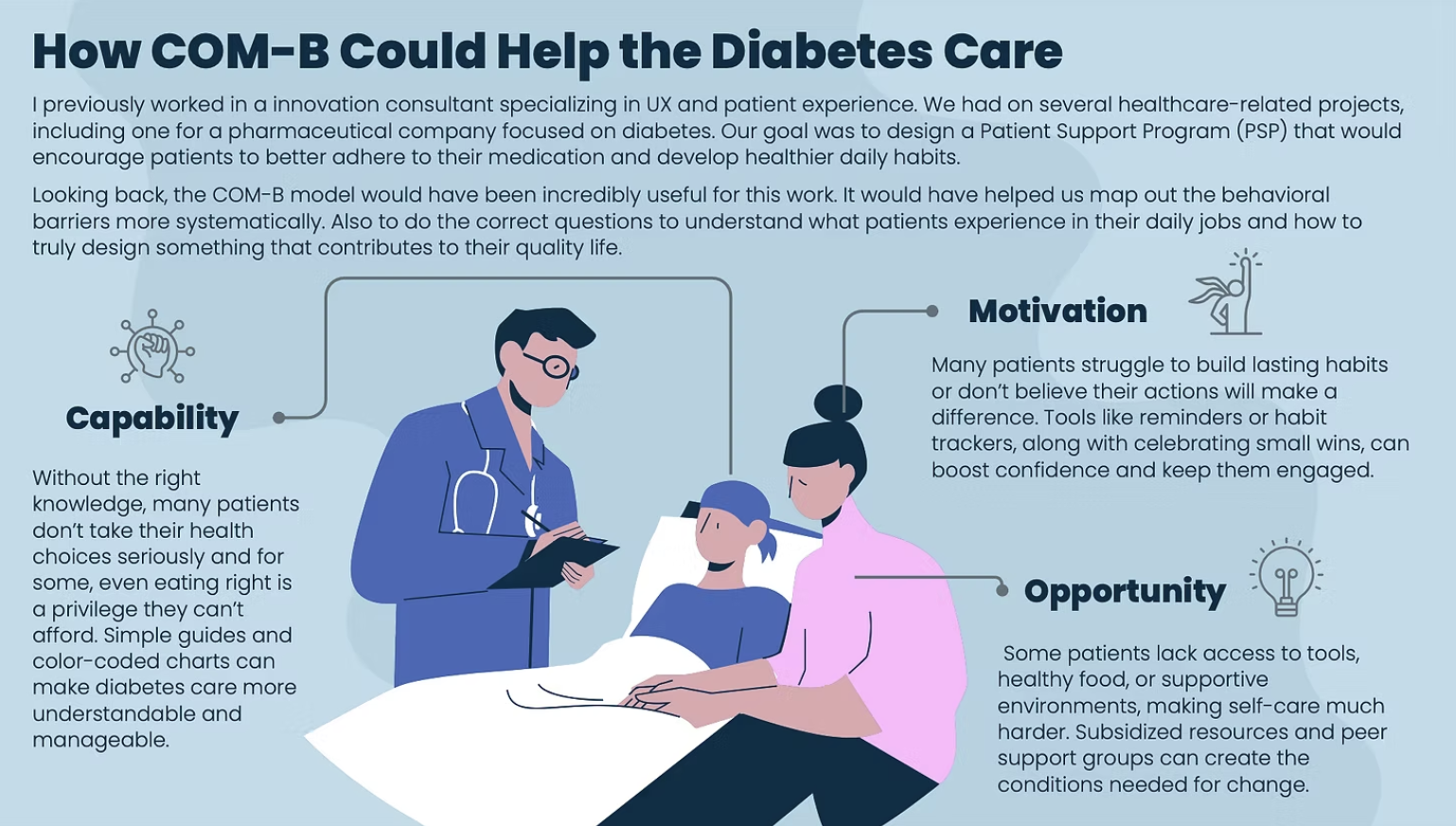
By Elena de Ureña Rodríguez on breaking down common behavioural barriers in diabetes care
In this piece, Elena reflects on a previous project in which she helped design a Patient Support Program (PSP) for people living with diabetes. The goal was simple in theory but complex in practice: encourage patients to better adhere to their medication routines and build healthier habits.
Looking back, Elena explores how the COM-B model, a core behavioural framework that maps out Capability, Opportunity, and Motivation as levers for Behaviour, could have strengthened the intervention.
Her visual breaks down common behavioural barriers in diabetes care, such as:
Limited Capability: Many patients lack clear knowledge or health literacy. Without understanding the “why” behind their daily actions, change feels abstract or irrelevant.
Restricted Opportunity: Healthy habits often require resources and supportive environments. For some patients, even access to nutritious food or medical tools is not a given.
Low Motivation: Behavioural fatigue, low confidence, or a sense that their actions “won’t make a difference” can all reduce patient engagement.
What Elena brings to life in her visual is how simple, intentional design choices, like color-coded guides, supportive peer networks, or habit trackers, can help shift these behavioural levers in an empathetic, effective way.
“Looking back, the COM-B model would have been incredibly useful for this work. It would have helped us map out the behavioral barriers more systematically. Also to do the correct questions to understand what patients experience in their daily jobs and how to truly design something that contributes to their quality life.”
It’s this kind of reflective, systems-aware thinking that behavioural design is all about. And it’s exactly what we hope to amplify through this series. We’re proud to share Elena’s work as our first featured piece, and to support the next generation of designers who are already asking the right questions and designing with purpose.

Author Bio
Elena de Ureña Rodríguez is a graduate student at IE University with a background in innovation consulting. She has worked on healthcare projects with a focus on user experience and patient support. Her interests lie in applying behavioural insights to practical challenges in the healthcare industry.
📢 Want to follow the full series? We’ll be featuring a new student insight each week as part of this ongoing series.
👉 Follow us on LinkedIn to stay updated!
#BehaviouralDesign #HealthcareInnovation #DiabetesCare #COMBModel #BehaviourChange #PatientExperience #StudentSpotlight #SustainabilityInPractice #HumanCentredDesign #Colectivo
