
Redesigning Sustainability Communication: From Messaging to Systems
As sustainability expectations evolve, so too must the way organisations communicate.
What was once considered a branding exercise is now becoming a matter of compliance, risk management, and trust.
With the introduction of the EU’s Empowering Consumers for the Green Transition Directive, the landscape has fundamentally shifted. Businesses are entering a new phase where sustainability communication must be not only compelling, but provable.
This raises a critical question: Are your communication systems designed for this new reality?
From Claims to Credibility
For years, sustainability communication has relied on broad, often ambiguous language. Terms like “eco-friendly,” “green,” or “sustainable” became widespread, but rarely substantiated.
The ECGT Directive changes this. It introduces stricter rules around environmental claims, requiring organisations to ensure that:
All claims are evidence-based and verifiable
Sustainability labels meet recognised standards
Consumers are protected from misleading or vague messaging
This is not a marginal shift. It represents a structural change in how organisations must approach communication.
The Risk of Business-as-Usual
Many organisations still treat sustainability communication as a layer added on top of existing operations.
But under the new regulatory environment, this approach creates risk:
Misalignment between operations and messaging
Exposure to regulatory scrutiny and penalties
Erosion of consumer trust
Communication can no longer operate independently from what is happening within the business. It must reflect it accurately.
Redesigning Communication Systems
At Colectivo, we approach this challenge through a Redesign lens. Rather than asking how to improve messaging, we ask: How might we design communication systems that are responsible by design?
This involves:
Key stakeholder engagement from the outset
Embedding sustainability data into communication processes
Aligning internal operations with external narratives
Creating governance structures for claims and disclosures
Ensuring consistency across marketing, reporting, and product-level communication
In this model, communication is not the final step. It is an integrated part of how the organisation operates.
Why This Matters Now
The Directive becomes legally enforceable across the EU in September 2026. This gives organisations a limited window to adapt.
Those who act early have an opportunity to:
Build trust through transparency
Strengthen their market positioning
Reduce compliance and reputational risk
Those who delay risk being forced into reactive change.
Join the Conversation
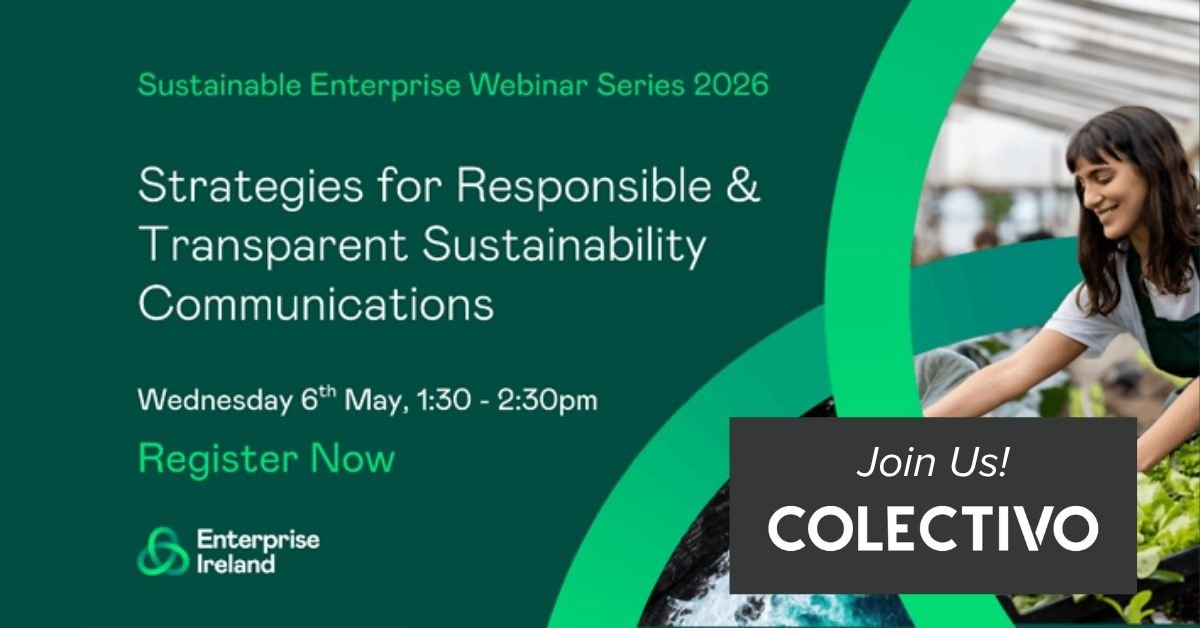
As part of the Enterprise Ireland Sustainable Enterprise Webinar Series 2026, Colectivo will be leading a session focused on strategies for responsible and transparent sustainability communication.
📅 Date: 6th May 2026
🕒 Time: 13:30 - 14:30 (GMT)
This session will explore how organisations can move beyond messaging and begin redesigning their communication systems for a more regulated, transparency-driven future.
👉 Register here: https://us02web.zoom.us/webinar/register/WN_D_y-bI9dQpuS-Jt79TClyw#/registration
