Risk Explanation 2: Extreme Weather Events
WEF Global Risks Report 2026: Short-term Risk #4 | Long-term Risk #1
Welcome to the second deep-dive of our 2026 series. Each month, we explore a critical global risk; unpacking its scope, key insights, and potential takeaways for your organisation. This month, we focus on the risk that has reclaimed the top spot for the coming decade: Extreme Weather Events.
Read more from the WEF Global Risk Report 2026 here: https://www.weforum.org/publications/global-risks-report-2026/?gad_source=1&gad_campaignid=22228224717&gbraid=0AAAAAoVy5F4n6xJZuOsSA2LdDDFvfnaT_&gclid=CjwKCAiAqprNBhB6EiwAMe3yhqP1_uq9Yjb0nxvAC0JimNRHWmjK0aJKpB2u9_B5KsCGYehKL9W3MhoCPnkQAvD_BwE
What is the scope of this risk?
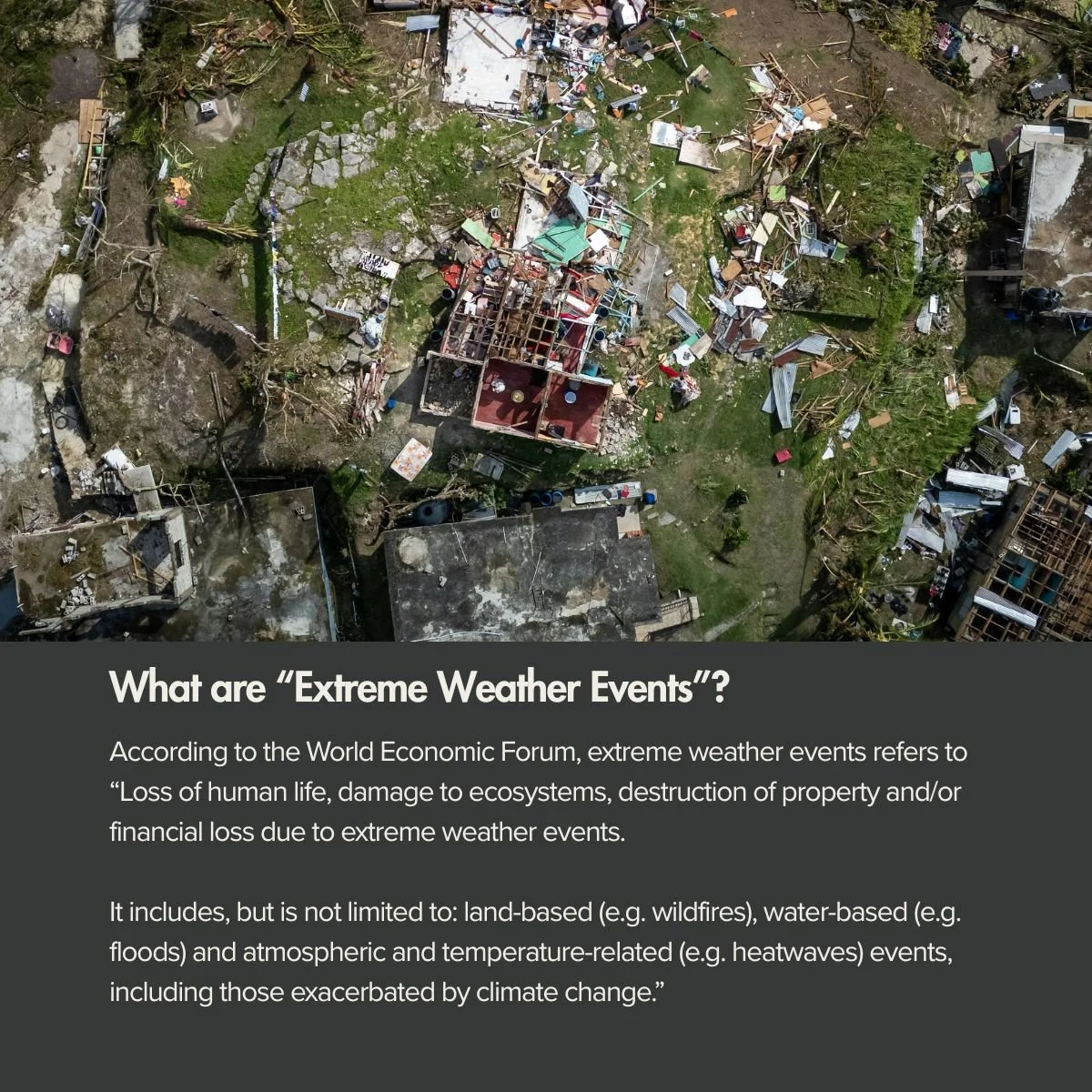
In the context of the Global Risks Perception Survey, extreme weather events encompass the loss of human life, damage to ecosystems, destruction of property, and significant financial loss resulting from severe climatic phenomena. This includes land-based disasters like wildfires, water-based events such as catastrophic flooding, and atmospheric or temperature-related extremes like record-breaking heatwaves. These events are no longer viewed as isolated occurrences but are increasingly understood as being exacerbated and made more frequent by human-induced climate change.
Fact File: Key Insights from the Report
The WEF’s 2026 report highlights a paradoxical shift in global perception where environmental concerns appear to be temporarily deprioritised in favor of immediate geopolitical and economic shocks. In the two-year outlook, extreme weather events have moved from the second to the fourth position, and the overall severity scores for all environmental risks have declined.
However, the report characterises this as a "downward reprioritisation" rather than a reduction in actual danger. Looking ahead to the next ten years, environmental risks remain the most severe threats facing the planet, with extreme weather identified as the absolute top risk.
Scientific data reinforces this long-term outlook, with the UN Environment Programme’s 2025 Emissions Gap Report estimating that global temperatures are likely to exceed the 1.5°C threshold within the decade. This warming is already manifesting in "climate costs" for modern economies, where infrastructure is becoming increasingly vulnerable. Extreme heat is currently placing energy grids under strain and affecting transport networks, while intensifying hailstorms impact the efficiency of renewable energy assets like solar panels. Furthermore, slow-onset events like the 2023-2024 Panama Canal drought have demonstrated how weather can create chokepoints in global supply chains, leading to price rises for consumer goods thousands of miles away.
Takeaway for Business: Thinking about your Organisation
The 2026 report offers a chance for organisations to reflect on their resilience strategies, ensuring they are not caught off guard by the short-term dip in risk rankings. The current shift in priority often stems from a fragmented geopolitical landscape where nations are focusing on immediate energy sovereignty. In this evolving landscape, viewing extreme weather as a fundamental business dependency rather than an external "extra" can help maintain long-term stability.
One way to use this information is by conducting audits of physical and digital infrastructure to identify hidden vulnerabilities. Since data centers are projected to consume up to 20% of global electricity by 2030 (Global Risk Report 2026, p.38), there is an opportunity for businesses to account for the strain this places on grids already weakened by heat and storms. Leadership teams might also find value in moving toward resilience strategies that prepare for "stranded assets”, and anticipate disruptions to coastal trade routes. By integrating these high-probability climate scenarios into strategic planning today, companies can move from reactive management toward proactive, design-led leadership in an increasingly turbulent world.