
Finding the Courage to Drive Change: What Business Looks Like Inside the Doughnut
At Colectivo, we believe that for sustainability to be FutureProof, it has to move beyond theory and into lived experience.
Earlier this month, I attended the GEC Sustainability Cluster Meet Up in Dublin on behalf of Colectivo, joining a cross-sector group of practitioners, founders, and sustainability leads exploring what it really takes to drive change within business.
This wasn’t a panel talk or a slide-heavy seminar. It was something far more challenging: a workshop designed to make participants feel the tension between business as usual and the future we need to build.
The session, Finding the Courage to Drive Change, was grounded in Doughnut Economics, a framework developed by Kate Raworth and advanced by the Doughnut Economics Action Lab. Its premise is simple, but radical:
The goal of business is not infinite growth, but to operate within a “safe and just space” that balances planetary boundaries with human wellbeing.
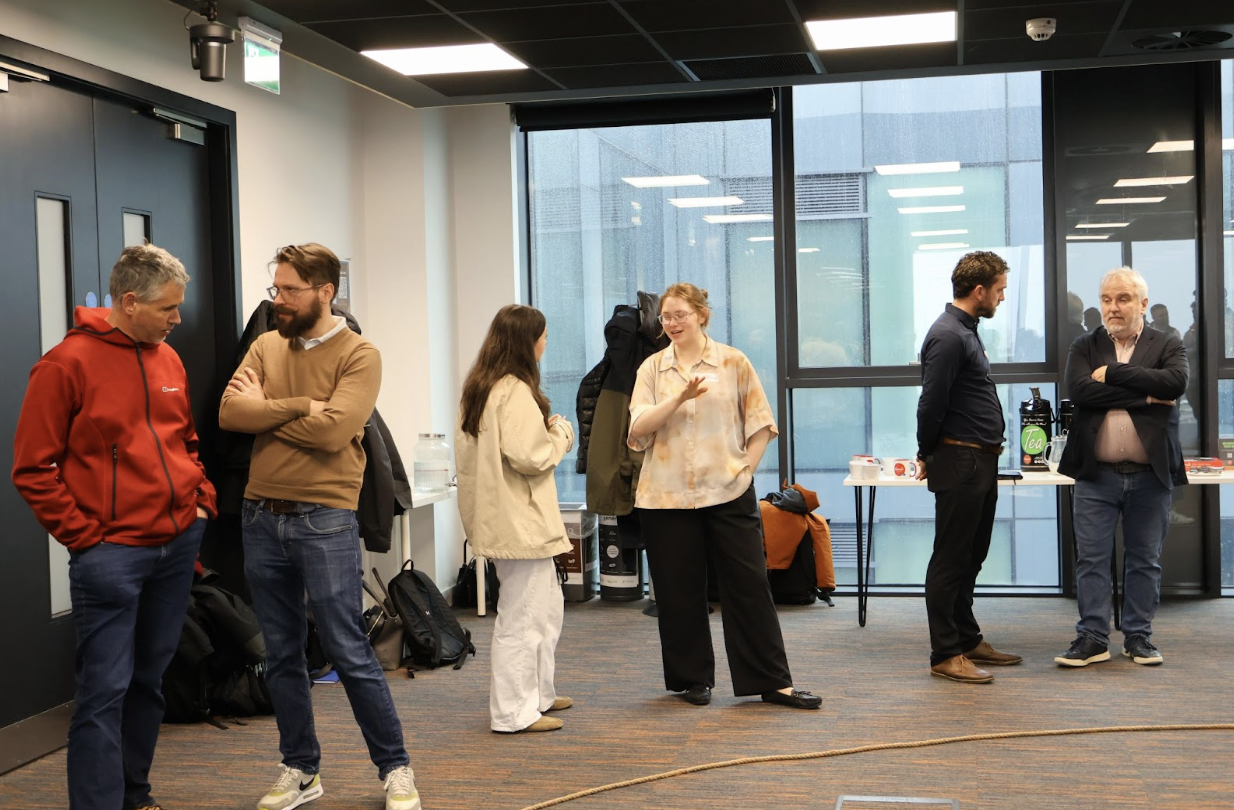
Breakout activities to encourage open communication.
From Concept to Experience
The workshop translated this idea into something tangible.
Participants physically mapped the “doughnut” using ropes:
An outer ring representing the ecological ceiling (climate, biodiversity, resource use)
An inner ring representing the social foundation (equity, livelihoods, access to essentials).
Between them lies the space where businesses should aim to operate.
By moving through these zones, from ecological overshoot to social shortfall, the framework stopped being abstract. It became immediate. This matters. Because one of the biggest barriers to sustainability is not a lack of data, but a lack of felt urgency.
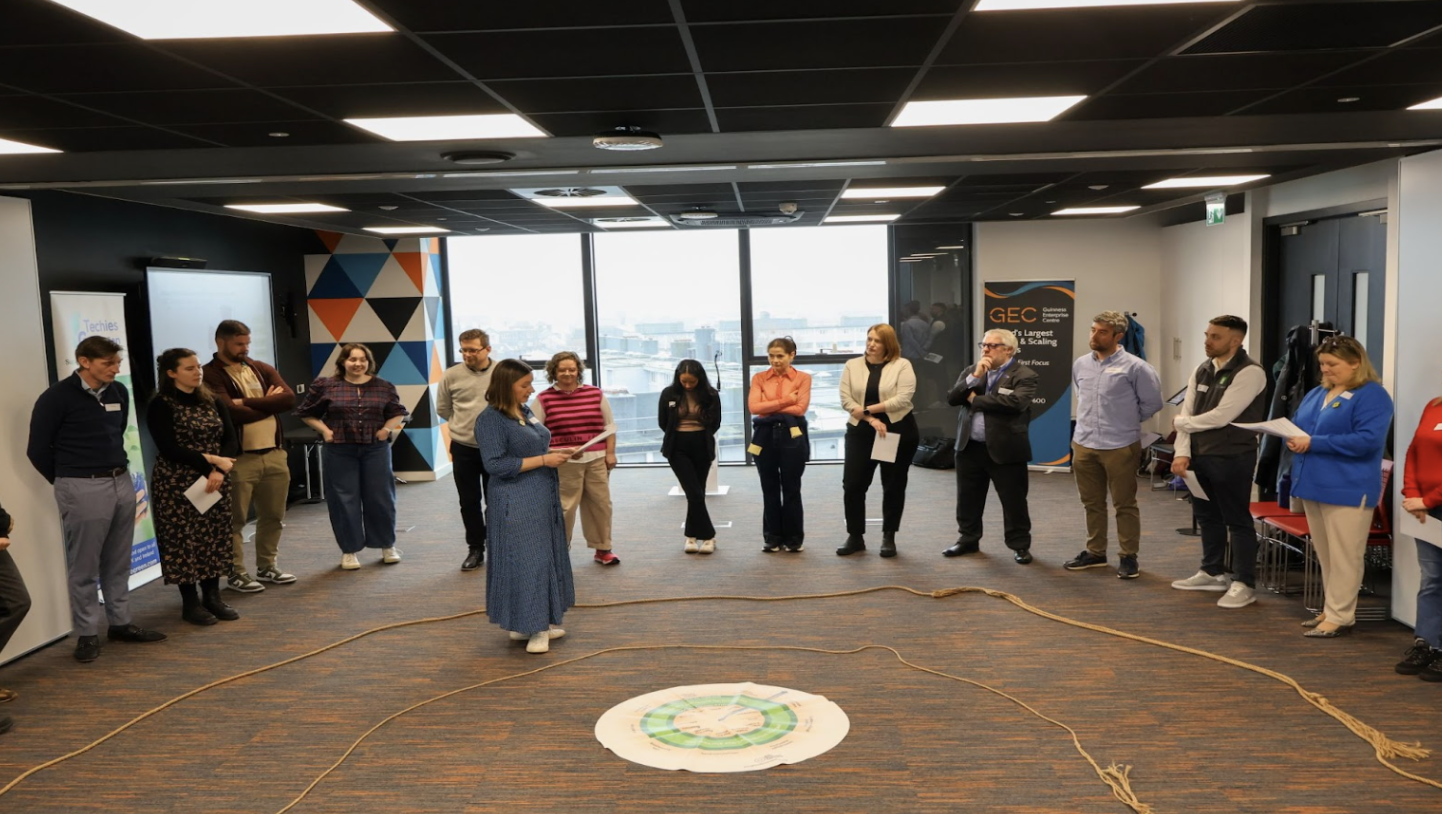
Participants physically mapping the "doughnut".
The Real Barrier Isn’t Ideas. It’s Design.
A key insight from the session, reinforced by case studies shared by Roisin Markham and the Irish Doughnut Economics Network, is this:
Transformative ideas already exist. But business design prevents them from scaling.
Across industries, organisations are encountering the same internal blockers:
Rigid financial targets.
Short-term return expectations.
Legacy processes.
Hierarchical decision-making.
The result? Innovation gets filtered out before it has a chance to succeed.
As one example highlighted in the session: ideas like refillable systems, modular products, or regenerative supply chains are often abandoned, not because they don’t work, but because they don’t meet existing margin expectations.
Redesigning Business: From Extractive to Regenerative
Doughnut Economics reframes sustainability not as an add-on, but as a design challenge.
This shift shows up in tangible ways:
From built-in obsolescence → repairable and modular design
From resource extraction → landscape restoration
From low wages → living wages and shared value
From closed systems → open collaboration and partnerships
In other words, sustainability becomes embedded in how value is created, not how it is communicated.
The Takeaway: Courage is a Design Choice
What this workshop made clear is that driving change is not about waiting for perfect conditions.
It’s about making intentional design choices:
Choosing long-term resilience over short-term optimisation
Prioritising systems thinking over isolated initiatives
Creating the conditions where transformative ideas can survive
Because ultimately, the question is not whether change is possible. It’s whether businesses are designed to allow it.
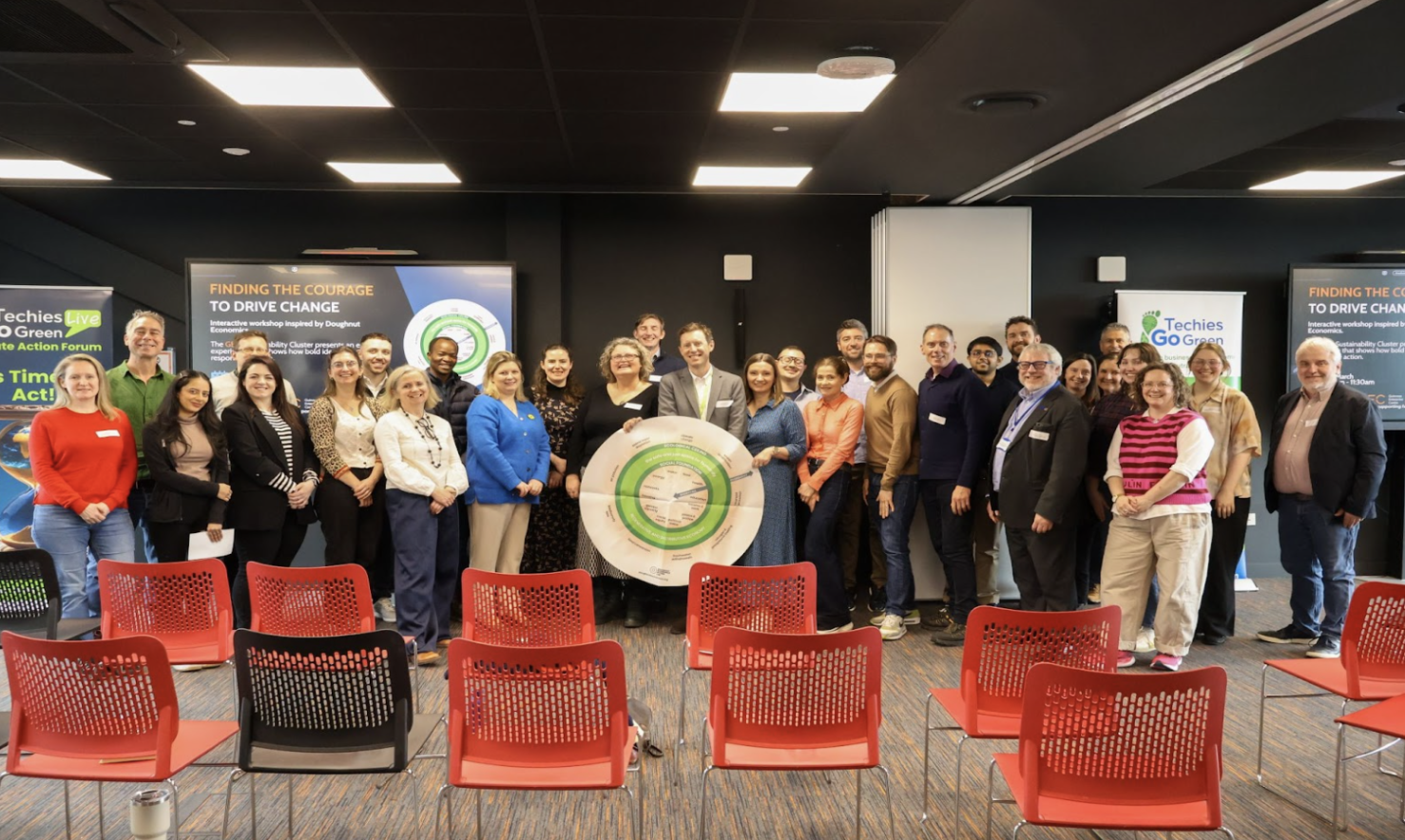
About The Author
Laura Brophy is completing her placement at Colectivo while pursuing a Bachelor’s degree in Geography and Geosystems at the University of Galway. Her academic focus includes sustainability, environmental systems, and building resilient futures. At Colectivo, she is learning how businesses can turn intentions into measurable impact, with a particular interest in making complex sustainability concepts clear and actionable.
