
B Lab NYC at Climate Week: Reflections
Written by Laura McDermott.
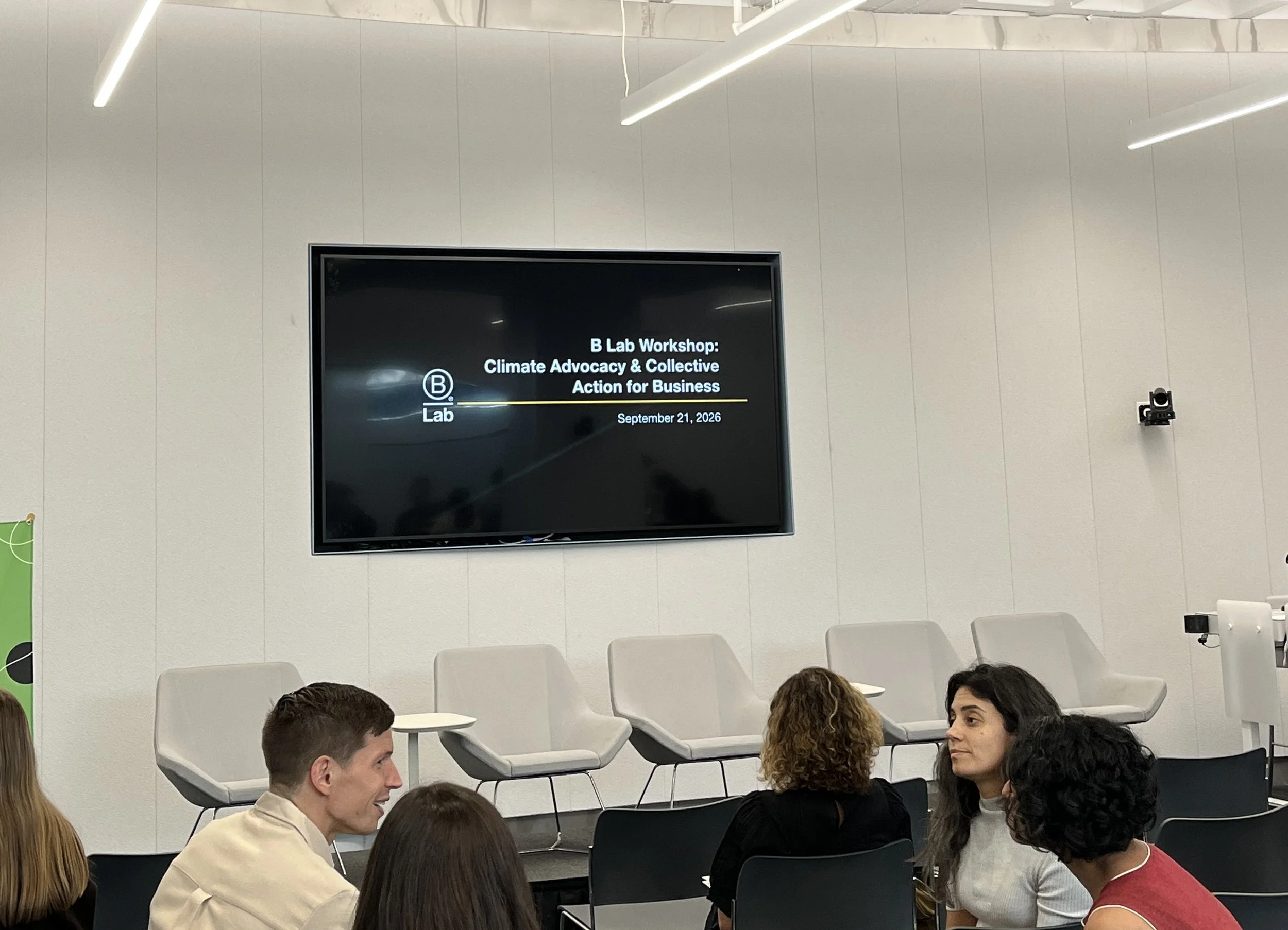
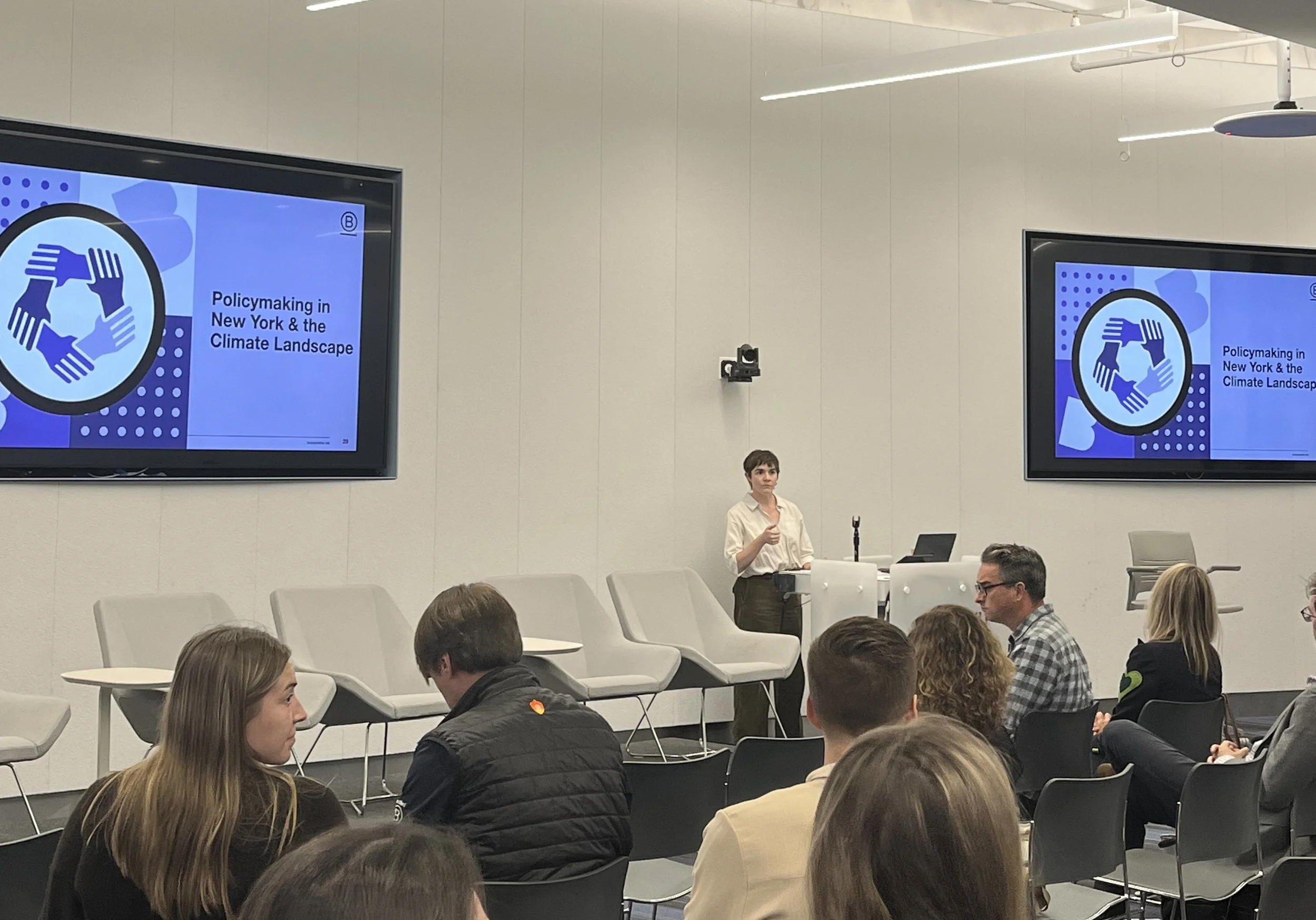
On Monday, 21 September, during New York Climate Week, I joined the B Lab NYC community at NYU Wagner for a workshop called Climate Advocacy & Collective Action for Business. The local community brings together more than 170 B Corps in New York and beyond. It was a room full of business leaders (XXL, as well as small) who believe business can be done better, asking what that means once you step beyond your own four walls.
As a B Lab-trained consultant, I work with the new standards every day. What I really wanted from this session was to see Government Affairs & Collective Action (GACA), the focus of the afternoon, through a US lens: how B Corps here are putting the advocacy requirements into practice, in a political system and climate moment very different from the one our clients navigate in Europe.
GACA, seen through a US lens
Under B Lab’s Standards V2, how a company engages with policy has its own impact topic: Government Affairs & Collective Action. It asks companies to work collectively for systemic change, to advocate for policies with positive social and environmental outcomes, and to be transparent about it. The standard is global, but hearing it framed for US companies changed how it lands. Here, advocacy can quickly read as taking political sides, lobbying is a large and highly visible industry, and climate policy can move fast in either direction at state level.
As a reminder, V2 is built on Foundation Requirements, which set eligibility and scope, and Impact Topic Requirements across seven areas. Requirements are tailored to a company’s size, sector and geography, and they phase in over time: some apply before certification (Year 0), and others by Year 3 and Year 5.
GACA has three parts:
GACA 1: a responsible and transparent approach to lobbying
GACA 2: working collaboratively to advance collective social or environmental impact
GACA 3: a responsible and transparent approach to tax, which applies only to the very largest (XXL) companies
Two definitions carry extra weight in a US context. Collective action is a sustained process of cooperation between stakeholders to bring about systemic change. Advocacy is treated as the same thing as lobbying: communicating with public officials to influence decisions, or trying to shape public opinion (beyond normal marketing) to influence public decision-making. That second definition is broad. For US companies, it means speaking up on climate policy falls squarely within scope, even when it’s through public campaigns.
In practice, every company needs a public responsible lobbying policy (GACA 1.1) from Year 0. For collective action, there are five recognised routes: mentorship, external research, multi-stakeholder collaboration, thought leadership and advocacy.
A lobbying policy doesn’t have to be long, but it has to be true
The workshop opened with three questions. Do you already have a policy? Are you the one responsible for writing it? And are you a little worried about it? That last one is fair: this is new territory for many businesses.
Many businesses are already active without calling it advocacy or collective action: they write to representatives, sign on to letters, mentor other founders, share research, partner with nonprofits, write op-eds or speak on panels. The line between lobbying, advocacy and collective action is blurrier than it looks, and they often overlap.
Business has a trusted voice, so learn where to use it
The second half of the afternoon moved from standards to the real world of policy. A short segment on the business voice in federal advocacy made a simple point: advocacy is influence with purpose. It cited a 2022 Gallup poll finding that 68% of Americans have a great deal or quite a lot of confidence in small business. Business leaders are a trusted, informed voice in their communities, and that voice can be used for good.
The speakers were candid that business often uses its political weight to cause harm. B Corps, with the right partners and infrastructure, can help balance that.
New York’s climate story, and why it’s at a turning point
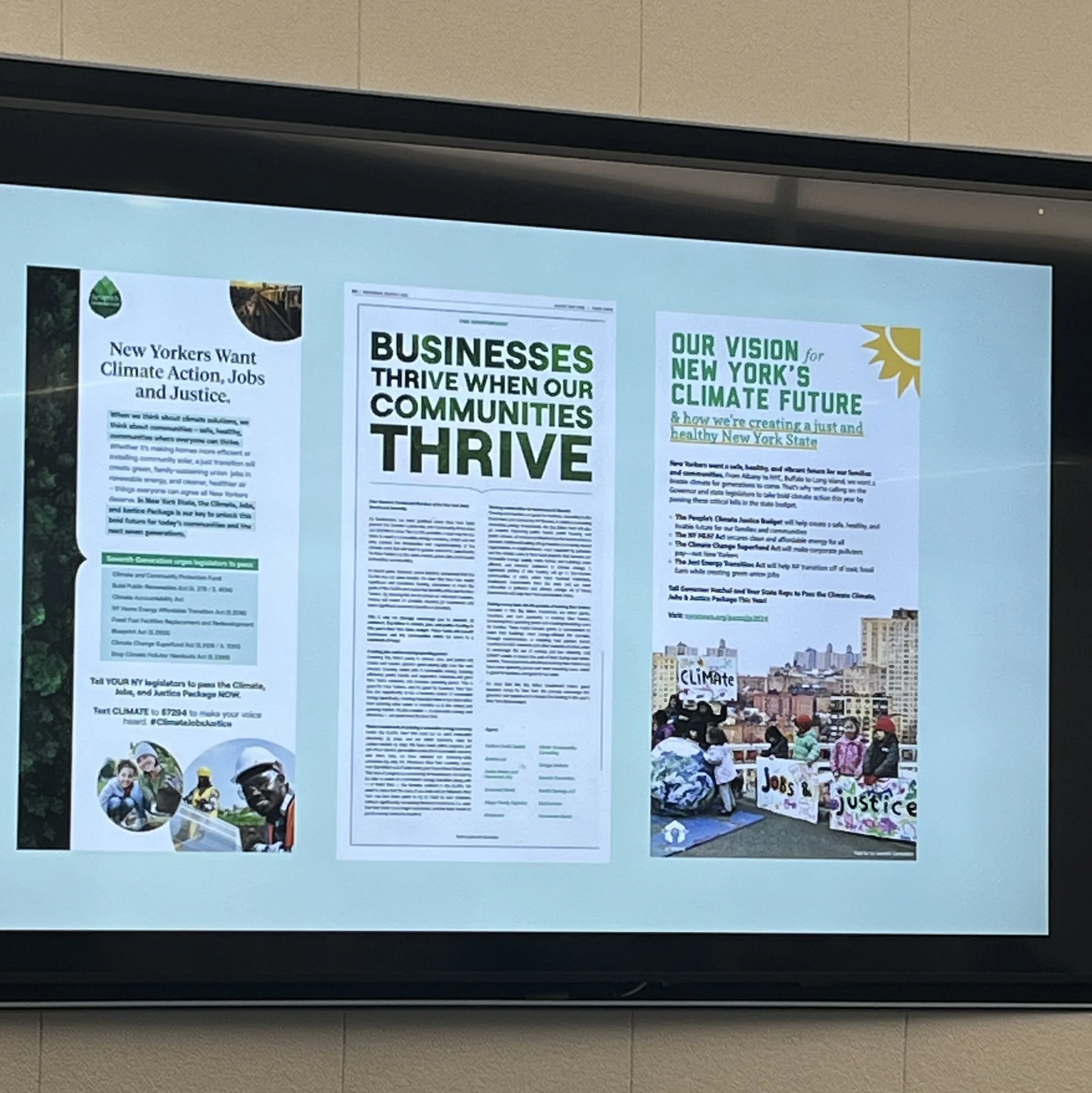
To close, we heard from NY Renews, a coalition of hundreds of climate, labour, youth and community groups across the state that formed after the People’s Climate March in 2014. We also heard about the New York City Environmental Justice Alliance, which unites communities of colour across the five boroughs that carry a heavy pollution burden.
New York has made real progress in recent years:
2019: the Climate Leadership and Community Protection Act (CLCPA), at the time the strongest climate law in the US
2021: a constitutional right to clean air, clean water and a healthy environment
2022: the State Environmental Bond Act
2023: the Build Public Renewables Act and the All-Electric Buildings Act
2024: the Climate Superfund Act, making polluters pay
2025 and 2026: $1 billion each year for the Sustainable Future Program, funding community-led climate projects
But the speakers were clear that the state is now in hot water. In 2026, key parts of the CLCPA were rolled back:
Methane is now counted over 100 years instead of 20, which makes emissions look lower on paper.
Targets have been loosened.
Regulations that were due in 2024 have been pushed back to late 2028.
One win survived: the share of benefits going to disadvantaged communities now has a 45% goal and a 40% mandate, up from 35%.
Data centres and frontline communities
The issue that brought it all together was AI data centres. According to the speakers, 39 hyperscale proposals across New York would together use nearly 11 GW of power, close to what every household in the state uses at peak. Many are proposed near Indigenous Nations’ territory and frontline communities. They risk driving new fossil fuel infrastructure, straining the grid and raising bills.
The Responsible Data Center Development Act passed the legislature with bipartisan support. It would require the state to study the impacts of data centres, phase in clean energy requirements, and make sure developers, rather than communities and small businesses, pay for grid upgrades. It also introduces a one-year moratorium on new permits. At the time of the workshop, it was awaiting the Governor’s signature, along with the SUNNY Act.
What I’m bringing home to Europe
The same GACA requirements apply to a B Corp in Dublin or Madrid as to one in Brooklyn, but the starting point is different. In Ireland, lobbying is already regulated and made public through the Register of Lobbying, and at EU level there’s the Transparency Register. Policy also tends to be shaped in a more harmonised, less polarised way. For many European companies, GACA 1 will be more about writing down and publishing what they already do than about stepping into unfamiliar territory.
What the US lens made clear is that GACA isn’t really about lobbying in the narrow sense. It’s about recognising that your business already has a voice in policy, and choosing to use it deliberately, transparently and alongside others. Watching B Corps in New York weigh up how to do that in a far more charged environment was a useful reminder not to take our own context for granted.
For the companies we support on their B Corp journey, my advice is to start now:
Read the standard for your size. Every company needs a public responsible lobbying policy before certification.
Map what you already do. Mentoring, sharing research, industry partnerships and speaking at events may already count as collective action.
Write a short, honest policy. Cover political contributions, how you engage with policymakers, which membership bodies speak on your behalf, and how you’ll report on it.
Make it operational. Add it to your annual policy review, track the time you spend on collective action and advocacy, and get sign-off from your board.
Join something bigger. In Ireland, the B Corp community, industry networks and business coalitions on climate are natural places for multi-stakeholder collaboration.
Thank you, B Lab NYC
A big thank you to the B Lab NYC community for bringing us together, to NYU Wagner for hosting, and to Partake, Valrhona and Yerba Madre for keeping us fuelled.
If you’re working through GACA or the wider V2 standards and want a sounding board, get in touch through Colectivo or connect with me on LinkedIn.
Useful links
