
Beyond the Lecture: Why Game-Based Learning is Irreplaceable for Climate Resilience
Authored by Laura McDermott.
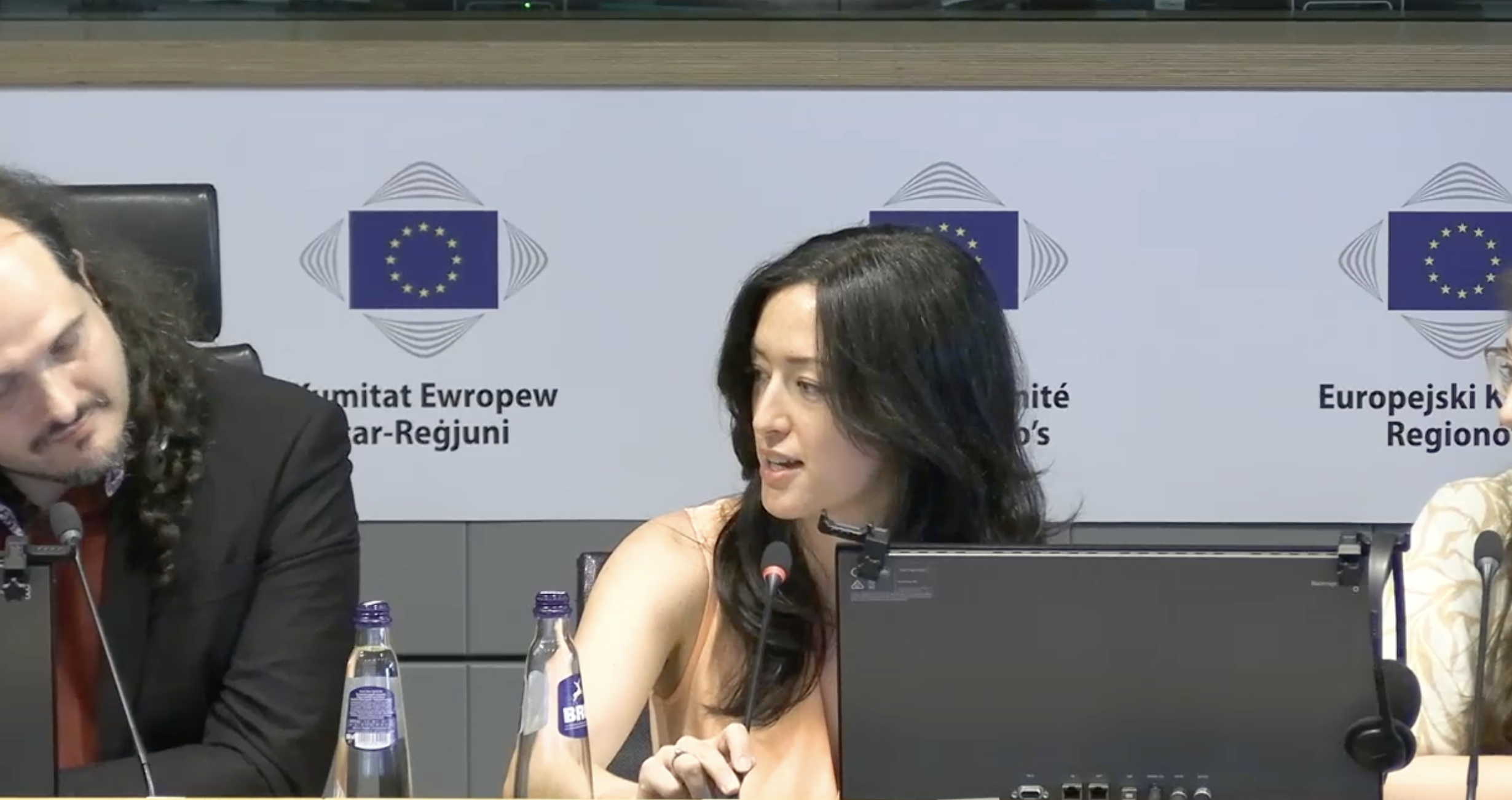
On 26th June, I had the privilege of joining the closing panel for the "Climate for All: Building Green Competences for a Resilient Europe" conference in Brussels. Sitting inside the European Committee of the Regions, the backdrop couldn’t have been more poignant: Brussels was enduring a severe heatwave. It was a terrifying, tangible reality check that pulled our discussions out of the realm of abstract theory and directly into the urgent present. We aren't just designing educational frameworks; we are working to build the resilience needed to face a rapidly changing climate head-on.

A massive thank you to Antonios Triantafyllakis and the brilliant team at All for Climate ASBL for bringing us together. Sharing the stage with such a solution-driven, creative group, including colleagues from European Commission DG EAC, DG CLIMA, the Nausika Foundation, and the Region of Crete, was incredibly inspiring.
Moving Past Data Overwhelm
As a consultant and an educator, my day-to-day focus relies heavily on leveraging the synergy of behavioral science, innovation, and design to address climate challenges. During our panel, “Building Climate-Resilient Citizens Through Competence-Based Learning,” we tackled a critical question: How do we avoid overwhelming people with climate data and instead engage them in genuine behavioral change?
Traditional, top-down lectures often leave citizens feeling paralyzed or detached. Game-based learning is frequently dismissed as a "nice to have": engaging, sure, but perhaps not "serious" enough for a crisis of this scale.
I argue the exact opposite. Experiential learning is irreplaceable. To build core GreenComp competences like systems thinking, futures literacy, and collective action, people need to navigate complex choices and feel the stakes firsthand. Games create a safe psychological space to simulate real-world political, corporate, and social dynamics, bridging the gap between passive awareness and active agency.
The Climate for All Games in Action
A major highlight of the day was stepping into the Foyer during the experiential coffee break, and later continuing the fun during the after-hours showcase. I had an absolute blast meeting the brilliant game designers from the consortium, including partners from Zavod EREA, Selkie Educational Foundation, and the International Youth Work Trainers Guild.

We got to test six incredible, open-access games designed for climate capacity building:
Spirit Path: A captivating Live Action Role Play (LARP) that forces players to grapple with collective action and systems thinking.
GREENWASH!: An excellent exercise in critical thinking that trains players to deconstruct corporate environmental claims.
SOLARPUNKs: A cooperative board game that beautifully fosters futures literacy.
The Elephant in the Room: A fast-paced debate game centered on problem framing.
Echoes of Gaia: A storytelling card game that sparks deep nature appreciation and exploratory thinking.
It’s Election Day!: A democratic simulation designed to cultivate political agency.
Looking Ahead: The Next 12 Months
As this project concludes, a powerful foundation has been laid: six concrete games exist, and a facilitator training programme is completely open-access. However, the gap between a successful pilot and systemic change is enormous.
Over the next twelve months, the challenge for our respective institutions is to move past strategy documents and figure out how to embed these experiential programs into how we train citizens, educators, and public servants alike. Europe is in a race between the speed of climate change and the speed of human adaptation, and tools like these give us a tangible path forward.
If you missed the live discussions in Brussels, I highly encourage you to check out the insights from the panel. You can watch the full official recording of the session here: Climate for All Conference Recording.

