
Book Club: Watch This
Kate Raworth: “A healthy economy should be designed to thrive, not grow”
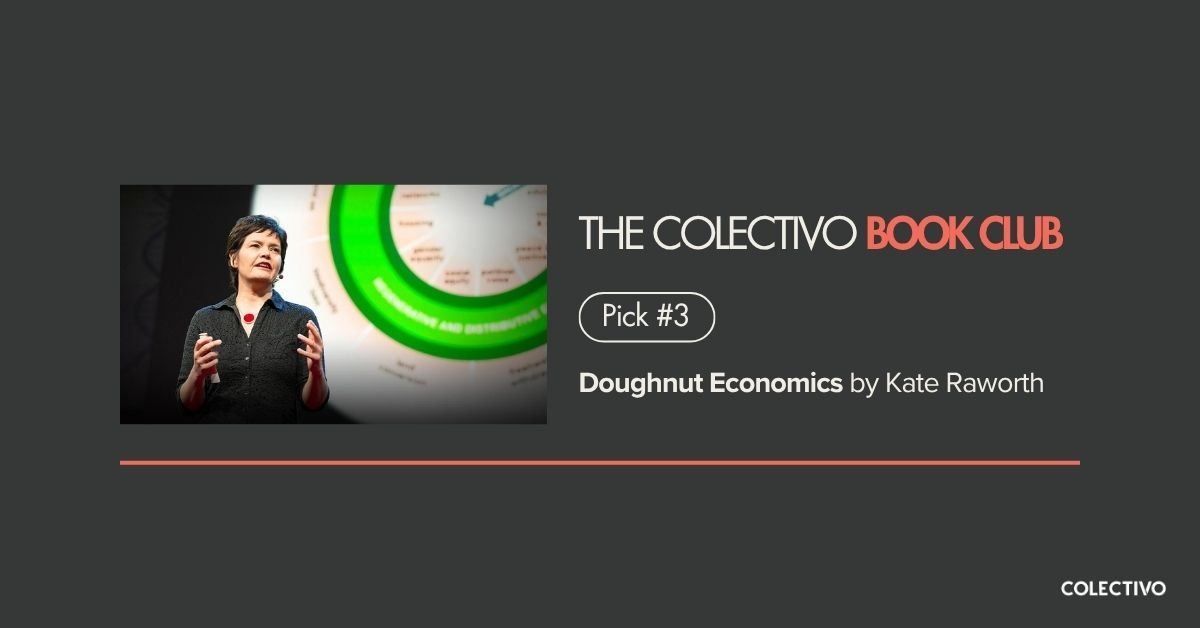
To accompany our latest Book Club pick, Doughnut Economics: Seven Ways to Think Like a 21st-Century Economist, chosen by Laura Brophy, we recommend watching Kate Raworth’s TED Talk, “A healthy economy should be designed to thrive, not grow.” https://www.youtube.com/watch?v=Rhcrbcg8HBw
The talk is a clear and accessible introduction to the thinking behind the book. Raworth challenges one of the most deeply embedded assumptions in modern economics: that growth should always be the central goal. Instead, she asks us to imagine an economy designed around thriving.
At the centre of this idea is the Doughnut model. The inner ring represents the social foundation: the essentials every person needs to live with dignity, including food, water, housing, healthcare, education, income and political voice. The outer ring represents the ecological ceiling: the planetary boundaries we must not overshoot if we are to protect the Earth’s life-supporting systems.
Between these two rings is the space where humanity can thrive.
Why this is worth watching is that it takes a complex idea and makes it simple without making it shallow. It gives us a way to think about social and environmental challenges together, rather than treating them as separate issues.
For organisations, this is especially relevant. The way we define success shapes the way we act. If growth is the only goal, then social and environmental impacts can become secondary. But if thriving becomes the goal, organisations are invited to think differently about value, responsibility and long-term resilience.
This talk is a useful starting point before reading the book, but it is also worth returning to afterwards as a reflection tool.
Questions to consider as you watch:
What does “thriving” mean in the context of your organisation or community?
Where is growth still treated as the main measure of success?
How might your organisation contribute to the social foundation?
Where might it place pressure on ecological limits?
What would change if decisions were designed around people and the planet from the beginning?
At its core, the talk asks a simple but powerful question:
How do we design economies, organisations and systems that are fit for the realities of the 21st century?
