
Colectivo Book Club Takeaways: Creative Confidence and the Infrastructure of Innovation
This month, the Colectivo Book Club explored Creative Confidence by Tom and David Kelley, a book that challenges one of the most persistent barriers to innovation: the belief that creativity is reserved for a select few.
At Colectivo, we see this assumption play out across organisations navigating sustainability and transformation. Teams are often rich in expertise, ambition, and intent, yet struggle to translate ideas into action.
What’s missing is not creativity, it’s the conditions that allow creativity to operate.

Debunking the Creativity Myth
The central premise of Creative Confidence is simple but powerful: creativity is not a fixed trait. It is a human capability that can be developed, strengthened, and applied.
Yet in many organisations, creativity is still treated as:
The responsibility of specific roles (designers, innovation teams)
A “nice to have” rather than a core competency
A moment of inspiration rather than an ongoing process
This creates a structural limitation. When creativity is confined, so is the organisation’s ability to respond to complex challenges.
In the context of sustainability, this becomes a critical risk. The Green Transition requires new ways of thinking, operating, and collaborating. It cannot be solved through linear problem-solving alone.
Creativity as Infrastructure, Not Talent
One of the most valuable reframes from the book is this: Creativity is not a spark. It is a system.
Innovation does not emerge from isolated moments of brilliance. It emerges from environments where people are encouraged to experiment, question assumptions, and test new approaches without fear of failure.
This has direct implications for organisations:
Are teams given space to explore ideas before being asked to justify them?
Is failure treated as a learning mechanism or a reputational risk?
Are diverse perspectives actively included in problem-solving processes?
Without these conditions, even the strongest strategies remain theoretical.
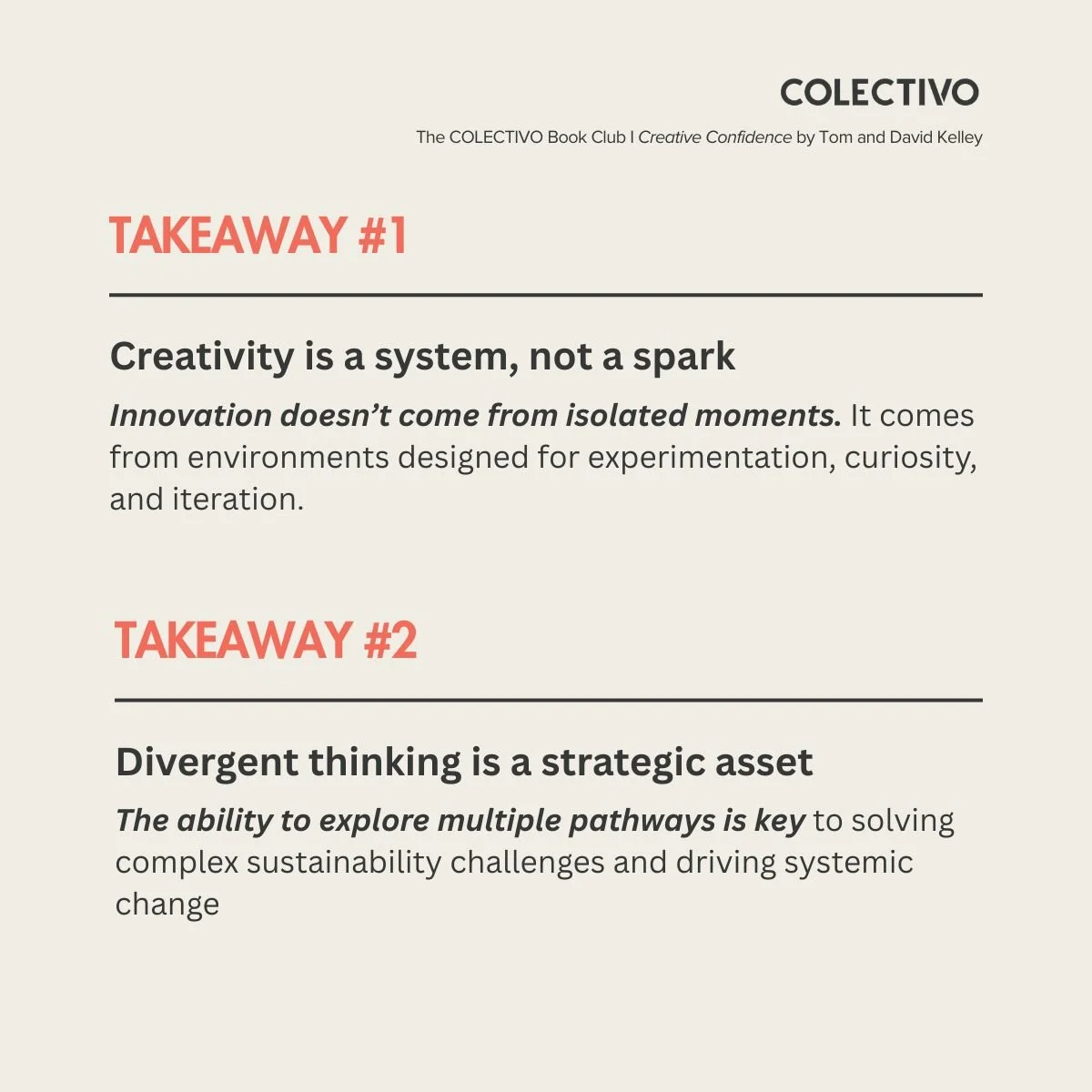
Divergent Thinking as a Strategic Asset
Many of us were naturally divergent thinkers, generating ideas freely and making unexpected connections. Over time, organisational structures often train this out of us, prioritising efficiency, predictability, and risk minimisation.
But in periods of transformation, especially within sustainability, divergent thinking becomes essential.
It allows organisations to:
Explore multiple pathways toward net zero and circularity
Reframe challenges from different stakeholder perspectives
Identify opportunities that sit outside traditional industry logic
Divergence expands the solution space. Without it, organisations risk optimising within outdated systems rather than redesigning them.
Convergence: Turning Ideas into Impact
While divergence is critical, it is only one half of the equation. Impact is created through convergence, the process of narrowing, testing, and implementing ideas.
This is where many organisations struggle. Either they move too quickly to convergence, shutting down exploration prematurely, or they remain in ideation without clear pathways to execution. Balancing these two modes is key: Diverge to explore possibilities and converge to create tangible outcomes
At Colectivo, this balance is embedded in how we design our programmes. We intentionally open up space for possibility, before narrowing toward solutions that are both practical and scalable.

The Role of Confidence in Driving Change
A recurring theme in Creative Confidence is that the barrier to innovation is often not capability, but confidence. People may have ideas, but hesitate to share them. They may see opportunities, but lack the permission to act. This creates an invisible gap between potential and execution.
Building creative confidence means:
Enabling participation across all levels of the organisation
Reducing the perceived risk of contributing ideas
Creating feedback loops that reinforce progress
In sustainability, where solutions require cross-functional collaboration, this becomes even more important. The best ideas often come from unexpected places.
Why This Matters for the Green Transition
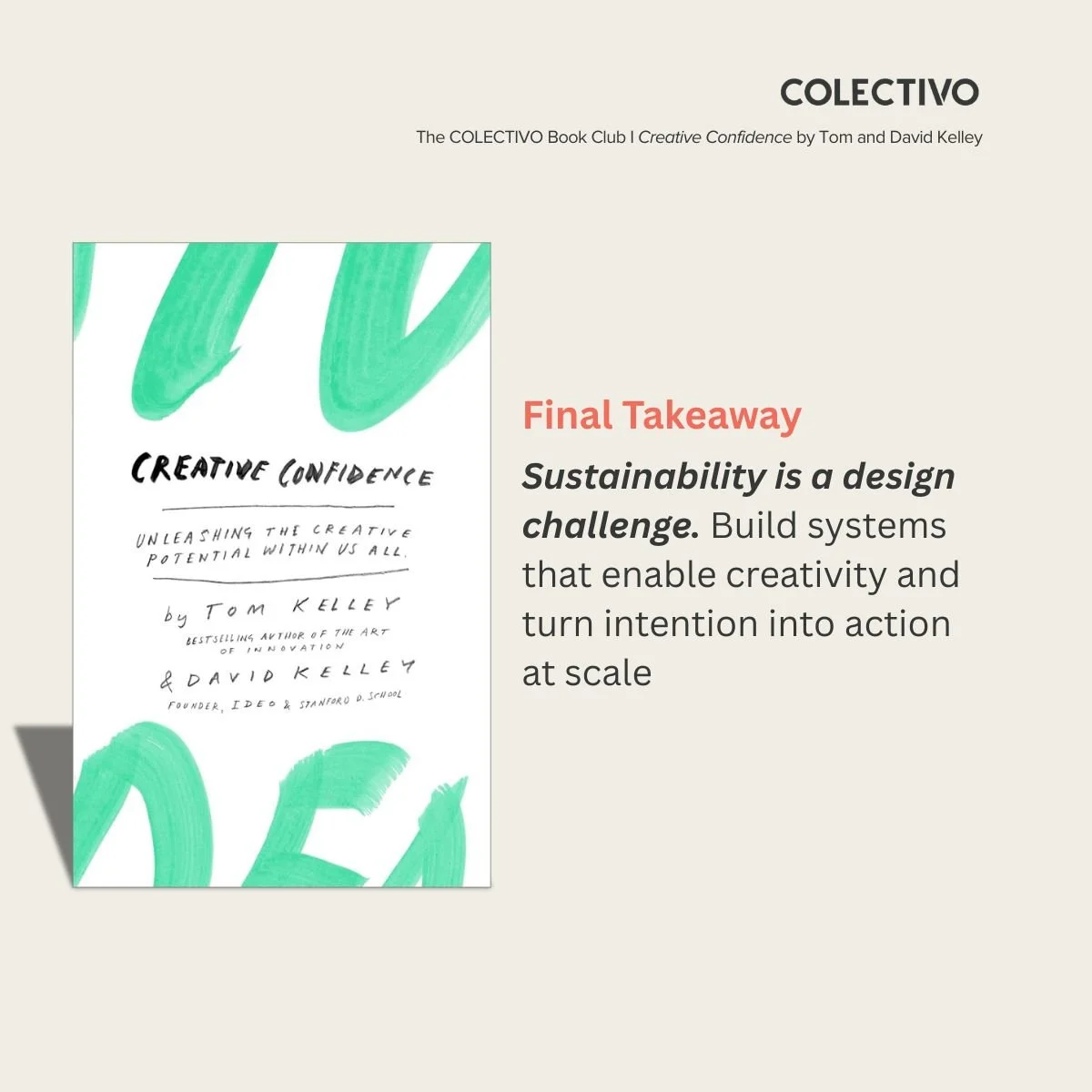
The transition to a more sustainable, inclusive, and resilient economy is not just a technical challenge. It is a design challenge.
It requires organisations to:
Rethink systems, not just optimise processes
Integrate environmental and social considerations into decision-making
Navigate uncertainty with agility and openness
This cannot be achieved through rigid structures or purely analytical approaches. It requires creativity, not as an abstract concept, but as an operational capability.
From Insight to Application
The key takeaway from this month’s read is not simply that creativity matters. It is that creativity must be designed for.
Organisations that succeed in the coming years will be those that:
Build environments where experimentation is possible
Balance divergent and convergent thinking
Empower individuals to contribute to change
Treat innovation as a continuous, system-level process
Because ultimately, the question is not whether your organisation has creative potential, it is whether your systems allow that potential to translate into action.
Join the Colectivo Book Club
The Colectivo Book Club is designed to support deeper reflection on the challenges shaping business and society today.
Every two months, we explore a new book or documentary connected to sustainability, innovation, and transformation. In alternating months, we share key takeaways to help translate ideas into practice.
You can engage individually or as part of a team.
👉 Stay tuned for our next selection and continue the conversation with us.

