
Why Good Intentions Aren’t Enough to Change Behaviour
During our recent BS for Employee Engagement webinar, we explored a challenge that almost every organisation faces when trying to drive change: The gap between what people intend to do and what they actually do.
In behavioural science, this is known as the Intention-Action Gap. It’s not a new concept, and most of us have experienced it ourselves. We set goals, we care about outcomes, and we fully intend to change, yet our behaviour often stays the same. The same thing happens inside organisations.
When Strategy Isn’t the Problem
Plenty of organisations today have:
Clear sustainability goals
Strong strategies
Engaged and motivated teams
And yet, progress can feel slow or inconsistent.
Recycling systems are introduced but not used.
New processes are rolled out but not adopted.
Sustainability goals remain part of presentations rather than daily work.
This doesn’t happen because people don’t care, it happens because behaviour is not driven by intention alone.
What Actually Drives Behaviour
Behavioural science shows us that our actions are shaped by a combination of factors:
Habits and routines
Physical and digital environments
Social norms and peer influence
Time, resources, and competing priorities
Even when people are motivated, these factors can make change difficult. That’s why simply raising awareness or asking people to “do better” rarely leads to lasting results.
From Intention to Action
To create real change, organisations need to move beyond awareness and motivation, and focus on designing for behaviour.
This means:
Making the desired behaviour easier to do
Removing friction and barriers
Embedding change into everyday workflows
Aligning systems, incentives, and environments
When behaviour is designed effectively, change becomes more natural, consistent, and scalable.
Introducing Behaviour Change for Sustainability (BCS)
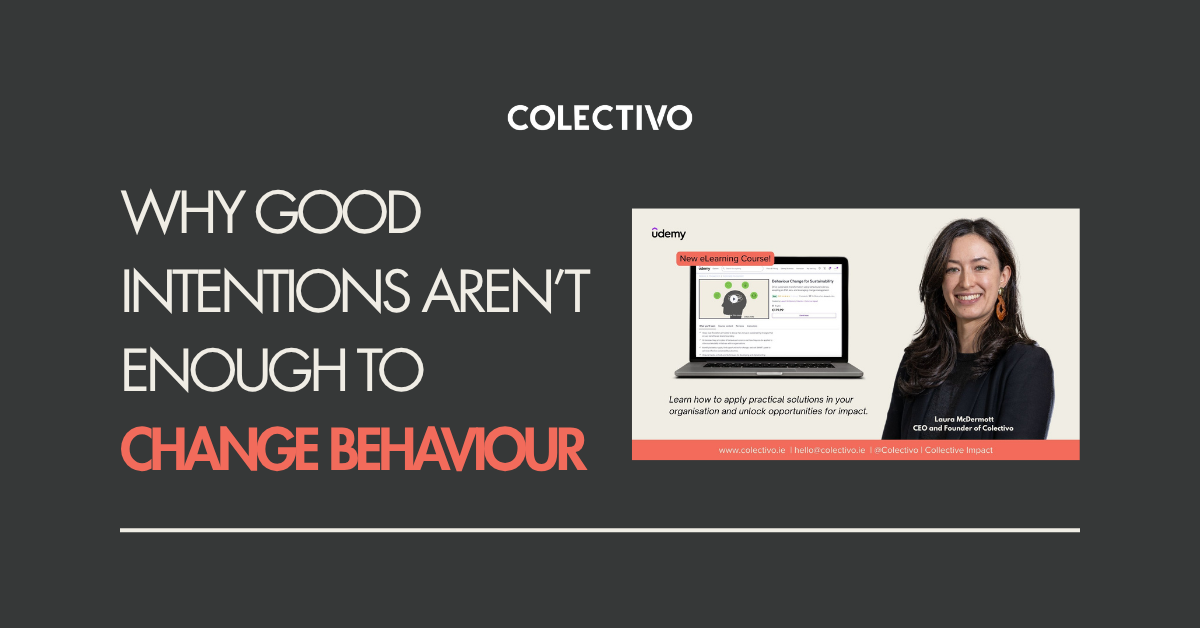
This is exactly the focus of our course Behaviour Change for Sustainability (BCS). The course is designed to help professionals and teams understand how to turn sustainability intentions into real, everyday action.
Inside the course, we explore:
Why behaviour change is often difficult, even when people care
How to identify the specific behaviours that sustainability depends on
How to use practical frameworks, such as COM-B, to diagnose barriers
How to design interventions that are realistic, human-centred, and effective
The goal is not just to understand sustainability, but to make it actionable.
👉 Explore Behaviour Change for Sustainability here:
https://www.udemy.com/course/behaviour-change-for-sustainability-with-colectivo/
From Strategy to Implementation: BCS + SIP
For organisations looking to go one step further, Behaviour Change for Sustainability (BCS) can be combined with our Sustainability in Practice (SIP) course.
Together, they provide a more complete learning journey:
SIP helps you understand your organisation’s sustainability context, assess your current position, and define clear goals.
BCS helps you design the behaviours, systems, and environments needed to achieve those goals.
This combination bridges the gap between strategy and implementation.
👉 Learn more about the BCS + SIP bundle:
https://www.udemy.com/course/behaviour-change-for-sustainability-with-colectivo/
Designing Change That Actually Sticks
If organisations want to move from ambition to action, the key question is not just: “What should we do?” but “How do we make it happen in practice?”
Understanding behaviour is what allows organisations to answer that question. Because in the end, change doesn’t happen at the level of strategy, it happens at the level of everyday behaviour 🌱
