
Most of us say we want to support businesses that are better for people and the planet. But in the moment of choice, standing in a shop aisle or scrolling through an online checkout, do sustainability certifications actually change what we buy?
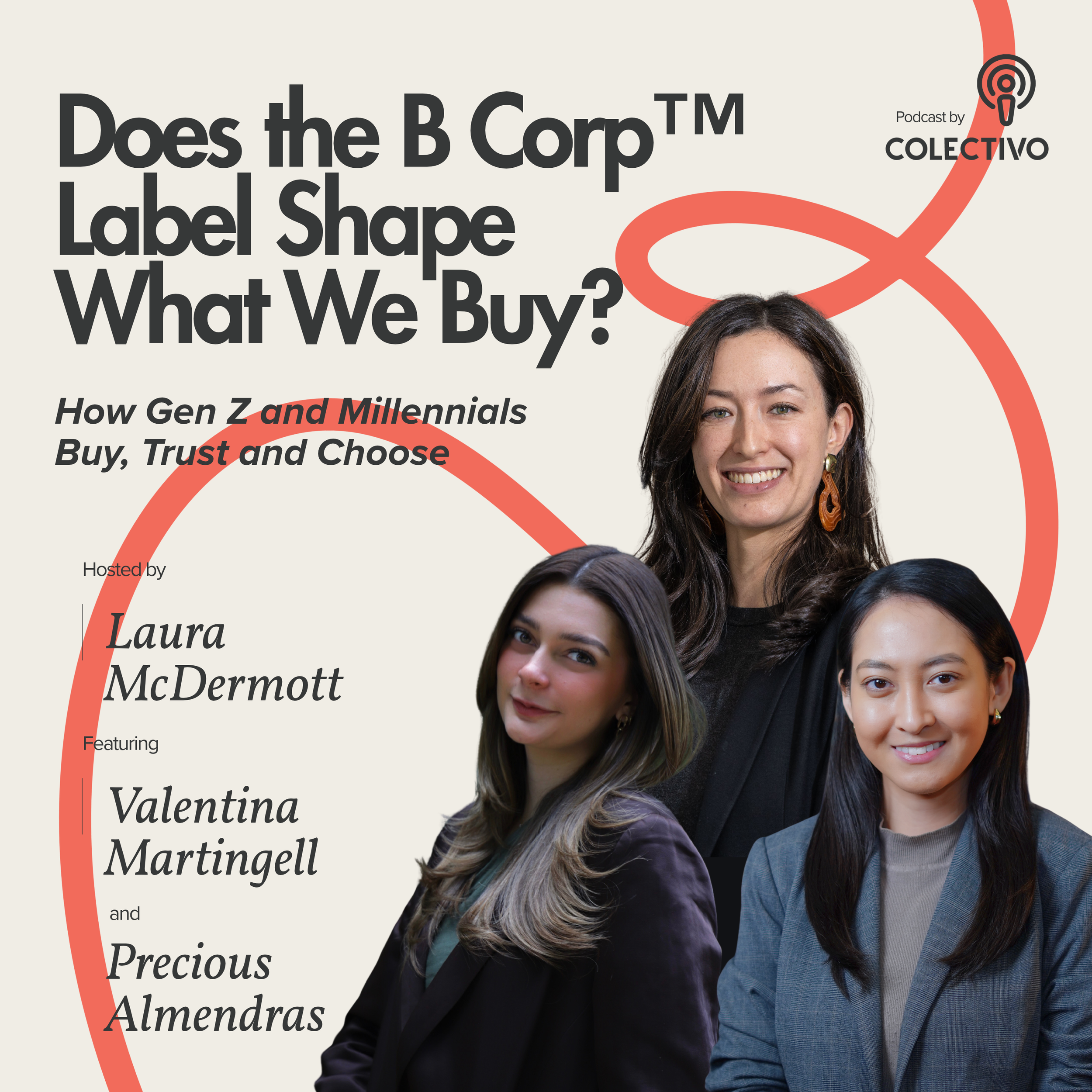
In the latest episode of the Colectivo podcast, Laura McDermott, CEO of Colectivo and a B Lab-trained B Corp™ consultant, puts that question to two members of the Colectivo community. Valentina Martingell brings a background in behavioural and social sciences, marketing, branding and consumer insights, and speaks from a Gen Z perspective. Precious Almendras brings experience in customer experience and innovation, and speaks as a Millennial and a Filipino consumer now living in Spain.
This isn't a technical conversation. It's a personal one: do consumers notice the B Corp label, what do they think it means, and does it shape what ends up in the basket?
Listen to the full episode, "Does the B Corp™ Label Shape What We Buy?", on Spotify
Two routes into sustainability: the classroom and the workplace
For Valentina, sustainability became personal through her studies. Behavioural science changed how she looked at consumption: why people make the choices they do, how habits form, and how much our environment shapes behaviour. It also taught her that sustainability is rarely the only factor in a purchase. Price, convenience and habit all compete for attention.
She sees her generation as broadly aware that faster change is needed. What her training adds is a different question. Not just "should we change?" but "how do we create the conditions that make change possible?"
Precious found her way in through work. Her first job was with an energy provider, where she first encountered the UN Sustainable Development Goals alongside energy conservation and efficiency programmes. That exposure made her far more attentive to which brands were genuinely acting on sustainability, and to what brands were telling consumers.
Culture shapes sustainable habits, often without the label
Both guests described growing up in collectivist, family-oriented cultures, in the Philippines and Mexico, where sustainable behaviour was simply practical. Clothes were repaired, reused and passed down between siblings and cousins. Nobody called it sustainability.
Precious noted that in the Philippines, choices are often driven by price and accessibility, and sustainable brands are widely perceived as more expensive. Moving to Madrid changed her daily habits in ways she hadn't anticipated. Good public transport, longer daylight hours and a walkable city meant she now happily walks 30 minutes to get somewhere, something she wouldn't have considered at home, where traffic congestion and car dependency are the norm.
Valentina's eye-opener was a textile recycling bin right outside her door in Madrid, something she had never seen in Mexico. Her awareness didn't change so much as broaden. The same value, keeping clothes in use, can be expressed through family hand-me-downs or through public infrastructure. Her conclusion: sustainable living depends heavily on the alternatives people can actually access day to day.
What the B Corp label actually means
B Lab is a global non-profit network that develops standards, policies and tools for responsible business. Certified B Corporations are assessed against those standards across the whole business, not a single product or campaign. That covers climate action, fair work, human rights, purpose and stakeholder governance, environmental stewardship and circularity. With the move to B Lab's new standards, the bar for certification has risen further.
Both guests had a similar first reaction to the logo: what does it mean? Precious looked it up and initially assumed it was simply a badge for green brands. Digging into the standards, she was surprised by how far it reaches, into fair work, diversity and inclusion, and governance. While reading, a Filipino bottled-water brand came to mind, one that funds the construction of public schools. She suspected it might be a B Corp because of the values she associated with it. It was.
Valentina first noticed the logo around 2019 on the door of a hotel, co-working and restaurant space in London. Researching it was the first time she realised sustainability isn't only about being green or recycling. Working with Colectivo later deepened that, showing her how sustainability runs through procurement, suppliers and the products a business uses. As she put it, B Corp doesn't just tell you the packaging is sustainable. It tells you how workers are treated and where the produce comes from too.
Laura pointed out that the label matters for business buyers as well as shoppers. When Colectivo chooses a venue for its Madrid gatherings, for example, picking a certified space like The Social Hub signals shared values. More of Colectivo's clients are now asking suppliers for certifications, and professional services firms, from marketing agencies to law firms, are certifying too.
A certification can't rescue a poor experience
Can a B Corp label make up for a bad customer experience? Precious's answer was clear: no.
The logo may prompt a first purchase. But customer experience is built on what practitioners call "moments of truth", the critical interactions that shape how a customer feels about a brand. If a brand fails to deliver its values at any of those moments, the impression turns negative quickly. And with alternatives available for almost every product and service, switching is easy.
The lesson for B Corps: the values in your certification and the experience you deliver need to line up. The label opens the door, but the experience decides whether customers come back.
Making the label count at the moment of choice
From a behavioural science perspective, Valentina argued that how options are presented shapes what people choose. Choice architecture and well-designed nudges matter as much as the certification itself. She offered three principles for B Corps:
Visibility. Show the label early, where decisions start, such as outside the shop or at the top of the page, so people notice it before they've committed.
Simplicity. Explain in plain terms what B Corp means for your business specifically, and what you're actually doing.
Relevance. Tell consumers why it matters to them and what they gain by choosing you.
She also stressed the sheer volume of information people face every day. Vague claims like "better for the planet" blur together. If someone wants a coffee, they'll usually go to the nearest café. Only a clear, specific message that avoids cognitive overload will shift that habit.
Precious added the power of story. Imagine hearing about a child who got an education because of the water you bought. Stories like that stick, get shared and drive word of mouth far more effectively than any badge on its own.
For B Corps looking for support here, Laura mentioned that B Lab's brand book and messaging guidelines offer practical ways to explain the certification simply.
From greenwashing to green shouting
The stakes for sustainability communication have changed. The EU's Empowering Consumers for the Green Transition Directive (EmpCo) now applies across Europe as anti-greenwashing regulation. Generic claims like "eco-friendly" are no longer acceptable, and misleading claims carry legal and financial risk.
But staying silent isn't the answer either. "Greenhushing", doing the work and saying nothing, deprives people of proof that change is possible. B Lab, together with Creatives for Climate and Nice and Serious, proposes a third path: green shouting. Its seven dials, ranging from humility to tone, help brands share transparent, credible stories of real progress.
A few brands already doing this well:
Tony's Chocolonely uses the inside of its wrapper to explain modern slavery in cocoa and how it pays a living wage in its supply chain. With Ben & Jerry's, it has worked on Tony's Open Chain to tackle exploitation in chocolate value chains.
Who Gives A Crap, the Australian toilet paper brand, pairs a playful, provocative name and colourful packaging with funding for sanitation where infrastructure is lacking. It educates without a two-page essay.
Longchamp and Rituals show how well-known consumer brands can raise the movement's visibility, alongside thousands of smaller B Corps driving change in their own sectors.
So, does the label shape what we buy?
It can, but not on its own. The B Corp label earns attention when people already understand it, when it's visible at the right moment, and when it's backed by a clear story and a customer experience that lives up to it. For certified businesses, the work doesn't stop at certification. Communicating it simply and credibly is the other half of the job.
Listen to the full episode, "Does the B Corp™ Label Shape What We Buy?", on Spotify. Follow the Colectivo podcast there for more conversations, from responsible tourism and eco-design principles to deep dives with our Featured Fellows.
Follow Colectivo on LinkedIn.
