
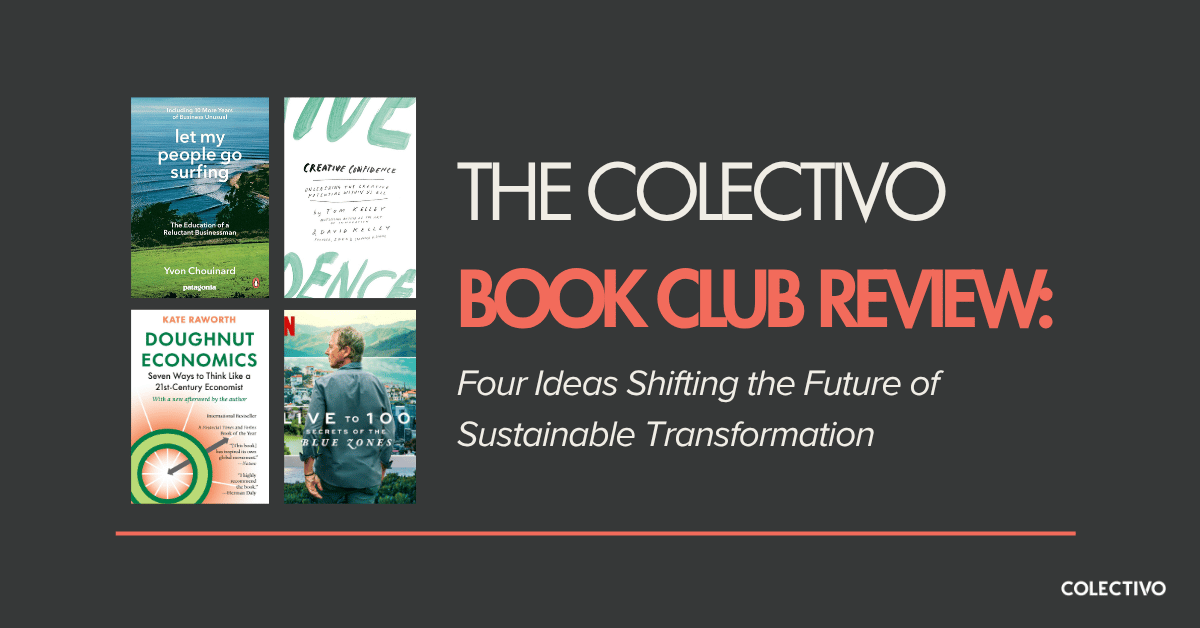
Welcome to the final deep-dive in our 2026 Colectivo Club series. Throughout the year, we have explored influential books, documentaries, and ideas that challenge how we think about sustainability, transformation, and resilience.
This time, we present our comprehensive end-of-year review, bringing together the core insights from across our 2026 selections.
The primary objective of the Colectivo Club is to provide business leaders with a space to step back from immediate operational pressures and engage with ideas that challenge conventional economic and corporate assumptions. In a business landscape often dominated by fast-moving market trends and complex regulatory tracking, deep, reflective reading acts as an essential strategic tool.
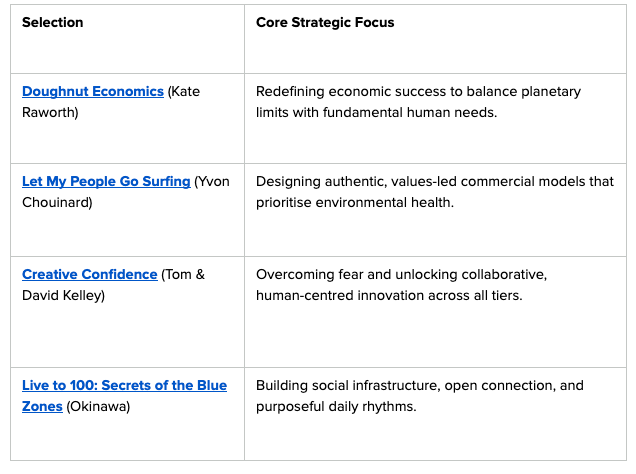
Throughout 2026, we have explored four diverse works, spanning macroeconomics, corporate governance, design theory, and social infrastructure. Individually, each piece provides an innovative solution to a specific contemporary challenge. When brought together, however, they reveal a comprehensive framework for organising modern businesses in a highly volatile world.
The table below outlines our four core selections for the year, mapping their primary strategic focus and their direct connection to Colectivo's consulting pillars, noting that our fourth pick shifted formats to explore a powerful documentary:
Four Overarching Reflections for our Network
By analysing the common threads across these four selections, we have derived four strategic reflections to help your business guide its transformation journey heading into the new year.
1. Sustainability is a Closed-Loop System
Kate Raworth's Doughnut Economics reminds us that business operations must stay within the ecological boundaries of the planet while protecting social foundations. This macro-level economic theory becomes operationally real through the business choices modelled in Yvon Chouinard's Let My People Go Surfing.
True corporate responsibility means accepting that your value chain has a closed loop. Waste, carbon, and social equity are not external factors to be ignored; they are core components of your operational balance sheet. To build a resilient enterprise, organisations must move away from linear models and design systems that actively restore environmental and social capital.
2. Innovation Requires Psychological Safety
To transition to a circular, sustainable business model, organisations must innovate rapidly. However, as Tom and David Kelley demonstrate in Creative Confidence, innovation cannot occur in an environment governed by corporate fear or strict conformity.
Unlocking the creative potential of your workforce requires building a culture of deep psychological safety and open dialogue, principles that are mirrored in the collaborative moai networks of Okinawa. When employees feel secure enough to voice concerns, propose alternative ideas, and experiment without fear of failure, the organisation becomes significantly more agile and adaptable.
3. Human Health Emerges from Cultural Design
The insights from our fourth pick, Live to 100, demonstrate that sustainable wellbeing cannot be achieved through isolated corporate wellness perks. Health, longevity, and long-term engagement are outcomes of structural design.
Resilient corporate environments are built by intentionally designing purpose into daily workflows, structuring schedules to support natural movement, and building authentic community connections. Human capital must be treated with the same regenerative focus that we apply to natural resources.
4. Authenticity is a Commercial Safeguard
In an era of rising regulatory scrutiny under the EU's Empowering Consumers for the Green Transition Directive (ECGT) and the Corporate Sustainability Reporting Directive (CSRD), performative sustainability is a major legal and reputational liability.
Yvon Chouinard's lifelong ethos at Patagonia shows that authentic, evidence-based, and transparent corporate communications act as a powerful commercial safeguard. When your strategic commitments match your internal culture and daily operations, your business builds deep, unshakable trust with clients, regulators, and employees alike.
Integrating the Lessons: From Ambition to Action
As we prepare for the opportunities and challenges of 2027, the central takeaway from the 2026 Colectivo Club is clear: the most successful organisations will be those that view sustainability, innovation, and workplace culture as a single, connected ecosystem.
Our specialised consultancy model is designed to help you integrate these insights into your business:
FutureProof: We help you map your operational boundaries, evaluate strategic materiality, and build robust ESG roadmaps that align with systemic global frameworks.
Activate: We work with your teams to build capability, break down communication silos, develop green leaders, and cultivate a workplace culture grounded in shared purpose.
Redesign: We facilitate collaborative co-creation sprints to help you redesign services, replace high-risk materials, and transition toward profitable, circular business models.
By linking macroeconomic boundaries with human-centred innovation and cultural values, modern businesses can move past simple compliance and confidently lead the transition to a sustainable economy.
Are you ready to bring the insights of the Colectivo Club into your business strategy for 2027? Contact our team today to find out how our FutureProof, Activate, and Redesign solutions can turn transformative ideas into practical, implementable actions for your organisation.
