
WEF Risks Report: Inequality (Short term risk #7, long term #7)
WEF Global Risks Report 2026: Short-term Risk #7 | Long-term Risk #7
Welcome to the fifth deep-dive in our 2026 series. Throughout the year, we are exploring critical global risks identified in the World Economic Forum's Global Risks Report 2026, unpacking their scope, key insights, and potential implications for organisations navigating an increasingly complex world.
This time, we turn to a risk that sits at the intersection of economics, society, and trust: Inequality. Ranked as the #7 most severe global risk over both the two-year and ten-year outlook, it is also identified as the most interconnected risk in the report for the second consecutive year.
Unlike many risks that emerge from specific sectors or events, inequality touches almost every aspect of how societies function. It influences access to opportunity, shapes trust in institutions, affects workforce participation, and can amplify other risks ranging from economic downturns to societal polarisation. As a result, inequality is increasingly being viewed not only as a social challenge, but as a fundamental resilience issue for organisations, economies, and communities alike.
Below is an overview of what businesses and professionals should know about this risk, and we encourage you to explore more from the WEF Global Risks Report 2026 here: The Global Risks Report 2026 | World Economic Forum

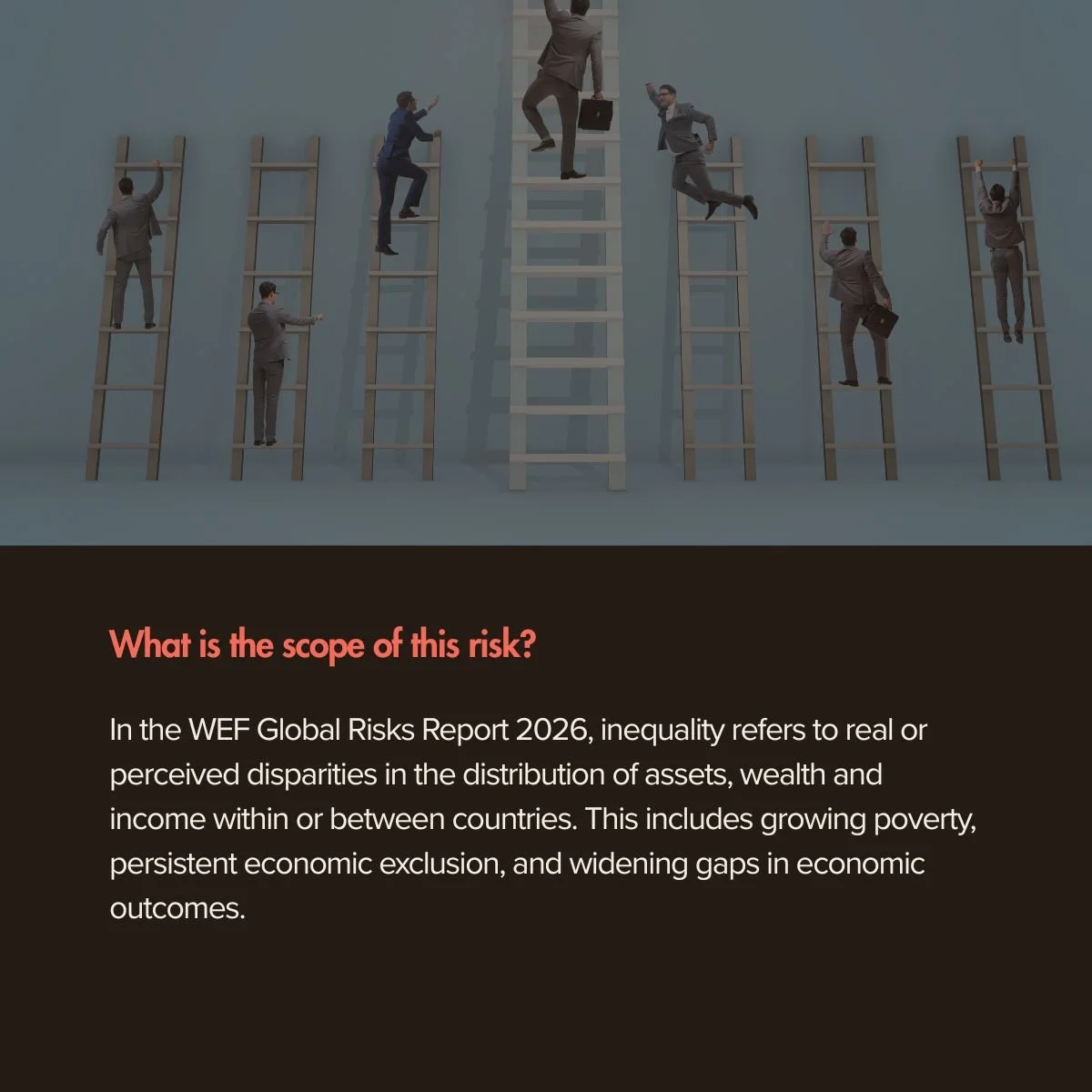


What is the scope of this risk?
In the WEF Global Risks Report 2026, inequality refers to real or perceived disparities in the distribution of assets, wealth and income within or between countries. This includes growing poverty, persistent economic exclusion, and widening gaps in economic outcomes.
At its core, this risk is about more than money. It is about whether people feel they have access to opportunity, security and a fair share in economic progress.
When inequality becomes entrenched, it can weaken trust in institutions, increase social tension and make societies more vulnerable to polarisation, misinformation, unrest and economic instability. The WEF report identifies inequality as the 7th most severe global risk over both the short-term and long-term horizon, meaning it is not seen as a temporary pressure point but as a persistent structural risk.
Fact file: What people should know
1. Inequality is one of the most interconnected risks.The report highlights inequality as the most interconnected global risk for the second year running. This matters because inequality does not sit in isolation. It links to economic downturn, lack of opportunity, societal polarisation, declining trust, insufficient public services and social protections.
2. It is both a short-term and long-term concern.Unlike some risks that rise or fall depending on the time horizon, inequality remains at #7 in both the two-year and ten-year rankings. This suggests that inequality is not just a current social issue, but a long-term resilience challenge.
3. It can weaken the social contract.The report notes that as wealth concentrates and cost-of-living pressures remain high, “K-shaped” economies may become more permanent. In simple terms, this means some groups continue to move ahead while others fall further behind, placing pressure on the relationship between citizens, governments and institutions.
4. It connects directly to business conditions.For businesses, inequality can show up through labour shortages, low employee trust, reduced consumer confidence, reputational risk, pressure on wages, supply chain vulnerability and increased expectations around social impact. It is not only a societal issue; it shapes the environment organisations operate within.
5. It is relevant in Ireland too.In the WEF Executive Opinion Survey, Ireland’s top risks over the next two years include economic downturn, insufficient public services and social protections, talent and labour shortages, and inequality. This makes the risk particularly relevant for Irish organisations thinking about resilience, workforce planning and social value.
Takeaway for business: What should organisations do with this information?
For organisations, the key takeaway is that inequality should not be treated as a distant global issue. It is a business risk, a trust issue and a strategic sustainability concern.
Businesses can begin by asking: who benefits from our growth, and who may be left out by it?
This applies across employees, suppliers, customers, communities and wider stakeholders.
In practice, this could mean looking at pay and progression, access to training, inclusive hiring, supplier diversity, affordability of products and services, local community impact, and whether sustainability strategies are designed with people in mind. An organisation may not be able to solve inequality on its own, but it can understand where it contributes positively or negatively.
For Colectivo-style work, this links closely to helping organisations move from broad ESG ambition to practical action. Inequality can be explored through stakeholder engagement, ESG maturity assessments, social impact mapping, governance reviews and programme design. The aim is not just to reduce harm, but to build organisations that are more trusted, resilient and responsive to the social systems they depend on.
In short: inequality is a signal that sustainability cannot only be environmental. A credible transition also needs to be fair, inclusive and connected to people’s lived realities.
