
Beyond the Strategy: Why Sustainability Demands Behaviour Change
How do we translate a high-level sustainability strategy into consistent, everyday operational habits? For many organisations, this is where the transition falters. A company might spend months establishing carbon reduction targets, mapping out materiality matrices, or aligning with the corporate non-financial reporting requirements. Yet, when it comes to daily execution, previous routines persist, paper waste remains high, and new circular processes are bypassed.
This common disconnect is not a failure of willpower or employee commitment. Instead, it is a well-documented behavioural phenomenon known as the Intention-Action Gap: the space between our strategic ambitions and our daily actions.
According to research from organisations such as the Behavioural Insights Team, simply raising awareness or delivering passive informational campaigns is rarely enough to change long-term habits. To build a genuinely resilient business, leaders must move beyond messaging and learn to design environments that support positive change.
Learning from the Field: Nuriyya's Experience
This systemic focus is the core philosophy behind our specialised Udemy course, Behaviour Change for Sustainability (BCS). Designed as a highly practical, self-paced learning pathway, the course helps professionals transition from environmental ambition to structured corporate action.
We recently received feedback from one of our course participants, Nuriyya, whose experience highlights the importance of clear, accessible frameworks in professional education:
"This course provides tangible insights for organisations to embark on their sustainability journey. It gives a practical framework for the multi-dimensional concept of sustainability and actionable steps to get started. The structure and format of the course really helps students comprehend and digest all information, with useful exercises at the end of each section. I'd recommend taking this course to anyone who wants to learn about how to establish sustainability practices in their organisations."
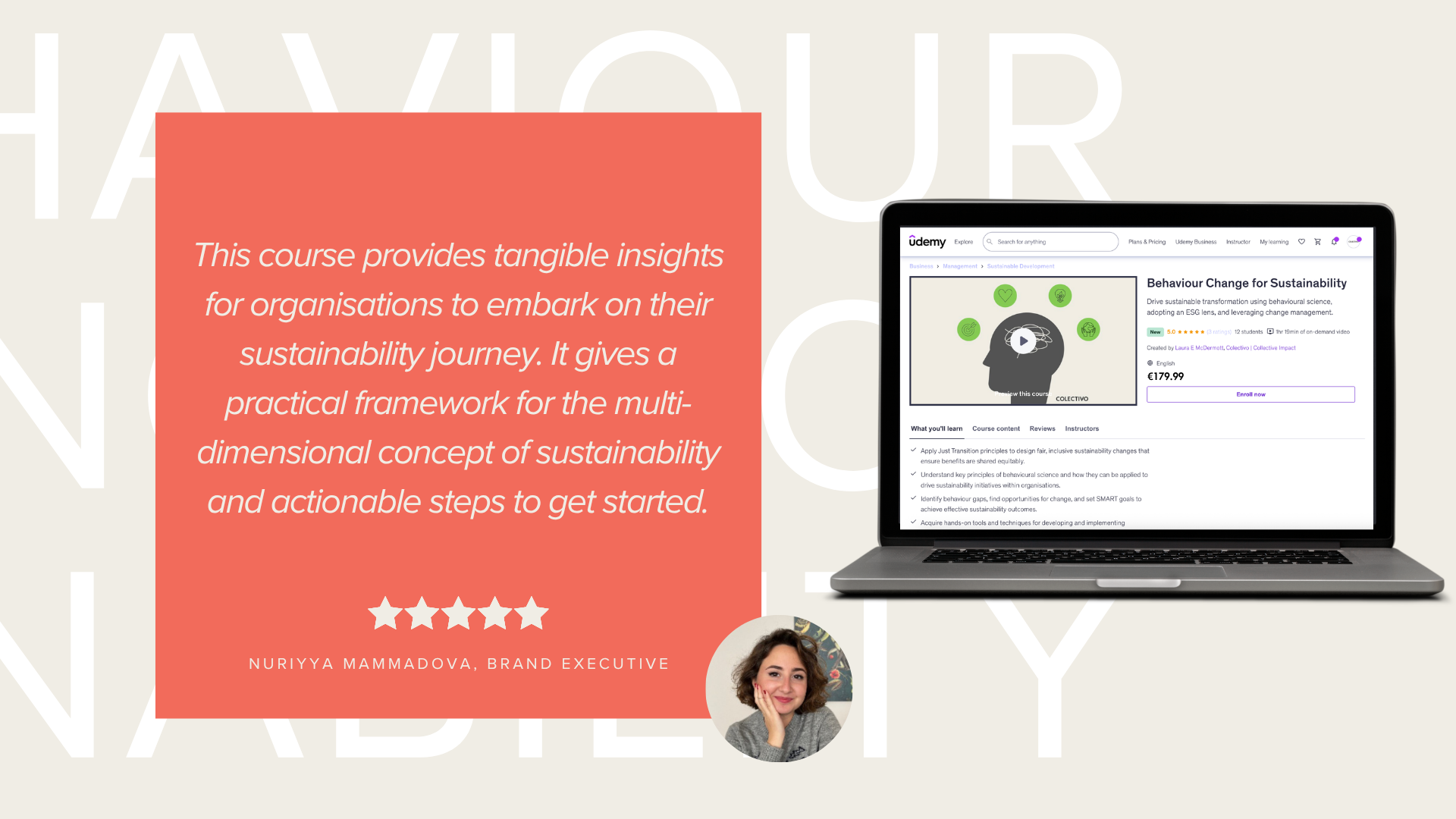
Nuriyya's feedback emphasizes three essential requirements for driving corporate change: structural clarity, practical diagnostics, and immediate, hands-on application.
Understanding the Dimensions of Behaviour: The COM-B Model
To address the multi-dimensional nature of sustainability, our BCS course is built on the COM-B model of behaviour, a widely recognized framework developed by behavioural scientists. This model proposes that for any desired behaviour to occur, three critical conditions must be present simultaneously:
Capability: Do your employees possess the necessary knowledge, physical skills, and cognitive understanding to execute the change? If an organisation introduces a complex waste-sorting system without providing clear, simple instruction, the change will fail due to a lack of psychological capability.
Opportunity: Does the physical, digital, and social environment actively support the new habit? Expecting staff to reduce carbon emissions while maintaining heavy travel schedules or unsupportive travel policies removes the structural opportunity to change.
Motivation: Do existing habits, corporate incentives, and social norms align with the desired action? If old, unsustainable habits are more convenient, cheaper, or socially reinforced, employees will naturally default to them.
By analysing these three dimensions, organisations can move past the common mistake of simply asking employees to "do better". Instead, they can diagnose the exact structural barriers blocking progress and design interventions that resolve them directly.
Transitioning from Theory to Action: Practical Exercises
A key element of the BCS course is its emphasis on active, experiential learning. As Nuriyya noted, the structure of the course is designed to make complex behavioural science digestible, with targeted exercises placed at the end of each section.
These practical tasks guide participants through a structured behavioural gap analysis. Rather than working with abstract, hypothetical scenarios, students apply the course frameworks directly to their own organisations. Throughout the curriculum, participants learn to:
Identify and define the specific, high-impact behaviours their sustainability goals depend on.
Map their workplace environments to uncover hidden points of friction and systemic barriers.
Design simple, low-cost interventions to make positive actions easy, visible, and socially reinforced.
This hands-on approach ensures that participants do not simply complete the course with theoretical knowledge. They leave with a practical, customized roadmap designed to implement real-world changes within their specific corporate environments.
Building Capabilities from Within: The Activate Pillar
At Colectivo, we believe that the transition to a sustainable economy cannot be achieved through outsourced compliance audits or temporary external checklists alone. While strategic consulting is invaluable for defining targets (FutureProof) or executing deep product overhauls (Redesign), long-term resilience must be built, nurtured, and maintained from within.
Through our flagship Activate programmes, we help businesses establish their own internal capabilities by developing "Green Champions" across all departments. Upskilling your team with behavioural science tools builds confidence, dismantles employee cynicism, and ensures that sustainability becomes a natural, shared component of daily decision-making.
When teams are trained to understand what actually drives human behaviour, they can collaborate more effectively, build stronger peer networks, and accelerate the transition from strategic intention to documented corporate impact.
Are you ready to bridge the Intention-Action Gap in your organisation? Enrol in our Behaviour Change for Sustainability (BCS) course on Udemy today to access our step-by-step diagnostic tools, practical templates, and hands-on exercises.
👉 Check out the course here: https://www.udemy.com/course/behaviour-change-for-sustainability-with-colectivo/?referralCode=427C1F374850B46B508B
