
Book Club: Doughnut Economics by Kate Raworth
What would it mean to design an economy that allows both people and planet to thrive?
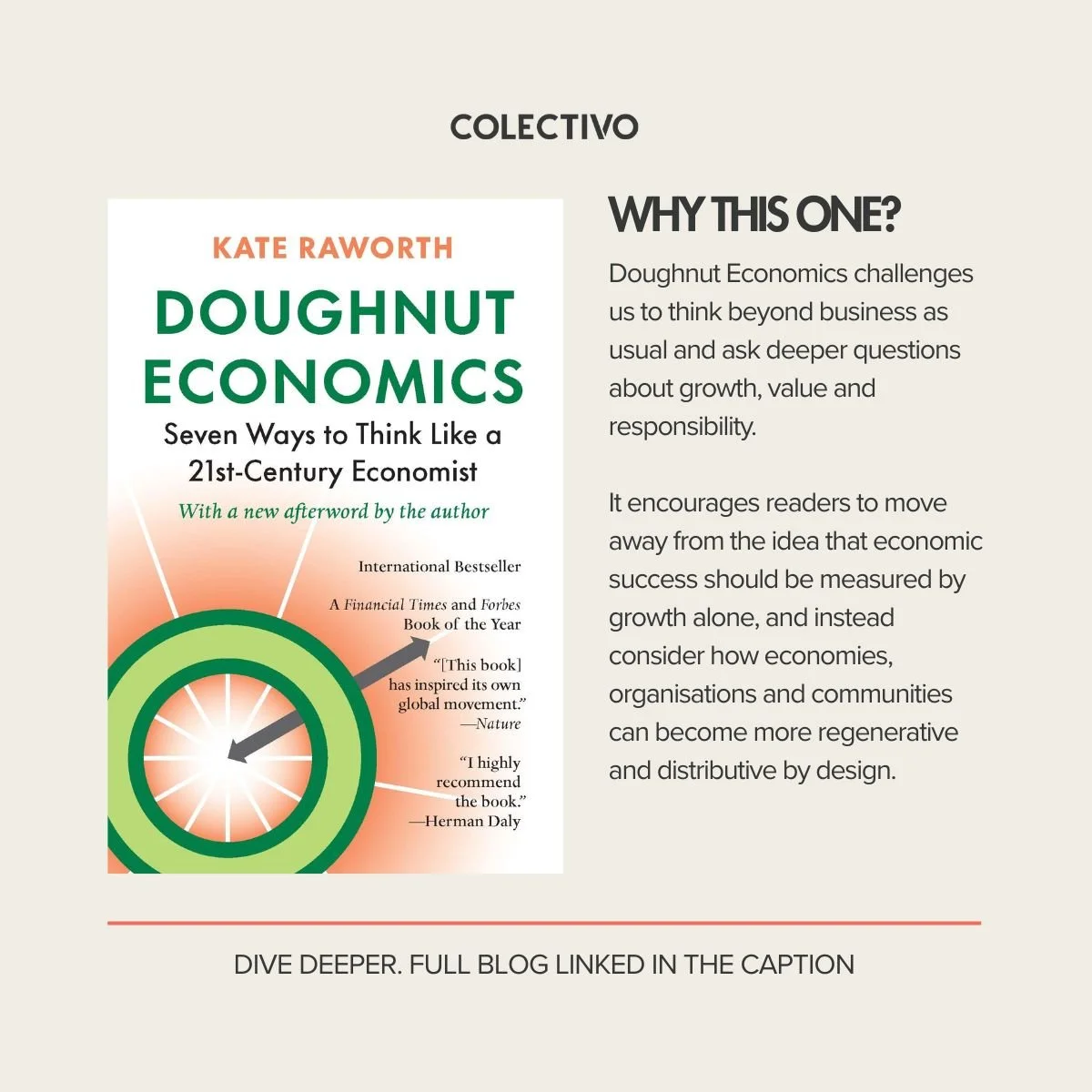
This is the question at the heart of Doughnut Economics: Seven Ways to Think Like a 21st-Century Economist by Kate Raworth.
At a time when organisations are being asked to navigate climate risk, social inequality, shifting regulation, resource pressures and changing stakeholder expectations, this book offers a powerful invitation to pause and rethink some of the assumptions that shape decision-making.
For many of us, economics can feel technical, abstract or removed from everyday life. Yet Raworth brings it back to something much more human: how we organise society, how we define progress, and how we decide what kind of future we are building towards.
The central idea of the book is the Doughnut model. The inner ring represents the social foundation: the minimum conditions people need to live with dignity, such as food, water, housing, healthcare, education, income, equity and political voice. The outer ring represents the ecological ceiling: the planetary boundaries we must not overshoot if we are to avoid destabilising the Earth’s systems.
Between these two rings is what Raworth describes as the safe and just space for humanity.
In simple terms, the book asks how we can meet human needs without exceeding ecological limits.
Why we chose it
After exploring purpose-driven business in Let My People Go Surfing and mindset-led innovation in Creative Confidence, we are moving into a wider systems lens.
Doughnut Economics was chosen by Laura Brophy, a Geography and Geosystems student at National University of Galway, who recently completed her placement at Colectivo. She chose this book because it challenges us to think beyond business as usual and ask deeper questions about growth, value and responsibility. It encourages readers to move away from the idea that economic success should be measured by growth alone, and instead consider how economies, organisations and communities can become more regenerative and distributive by design.
This feels especially relevant for organisations trying to understand their role in the green transition. Sustainability is no longer only about reducing harm at the edges of a business. It is about looking at the systems a business depends on and contributes to: supply chains, communities, ecosystems, infrastructure, policy and culture.
At Colectivo, this connects closely to how we think about sustainability strategy. Meaningful change rarely happens through isolated actions. It requires understanding the bigger picture, identifying where an organisation has influence, and designing pathways that connect ambition with action.
Raworth’s work gives language to this shift. It reminds us that the future is not only something to respond to. It is something we help shape through the choices, models and measures we use today.
What the book invites us to consider
One of the most useful parts of Doughnut Economics is that it does not only critique outdated ways of thinking. It offers a practical reframing.
Raworth sets out seven ways to think like a 21st-century economist, moving from old assumptions towards new possibilities. These include shifting from a focus on endless growth to thriving, from isolated markets to embedded systems, and from extractive design to regenerative design.
For businesses and organisations, this raises important questions:
What do we currently measure as success?
Where might our activities create social or environmental pressure?
How do we understand our role within wider systems?
Are our strategies designed only for efficiency, or also for resilience?
What would it mean to create value in ways that are fairer, more inclusive and more regenerative?
These are not simple questions, but they are increasingly necessary ones.
How to engage with this month’s pick
You can read Doughnut Economics independently, with a colleague, or as part of a group discussion. As you read, we encourage you to treat it not only as a book about economics, but as a prompt for reflection on your own organisation, community or sector.
Some questions to keep in mind:
What assumptions about growth or progress does this book challenge?
Where do you see examples of extractive or regenerative design?
How might your organisation contribute to the social foundation?
Where might it risk pushing beyond ecological limits?
What would change if success was measured by thriving, not just growth?
In the coming weeks, we will share a Book Club: Takeaways blog to support reflection and discussion.
To learn more and find a copy, check your local library, bookshop, e-reader platform or second-hand bookstore.
