
New York Climate Week Recap: Green Claims, Business Models and Food for Thought
New anti-greenwashing rules and the gap between strategy and the creative brief: what stayed with me from my first New York Climate Week.
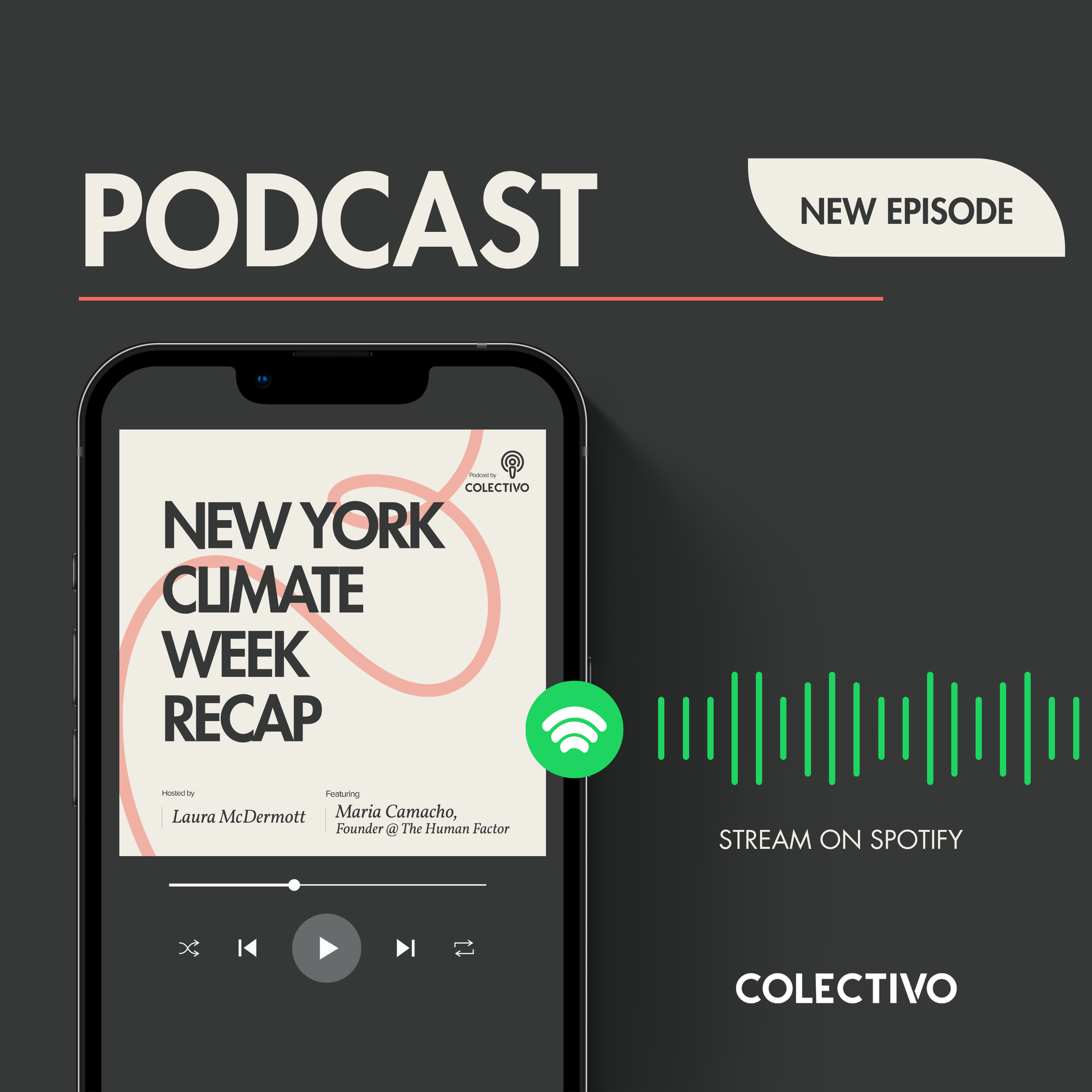
Most episodes of the Colectivo podcast dig into a framework, a process or a sector in transition. This one is different. Laura has just come back from her first New York Climate Week, and wanted to unpack the handful of talks and moments that actually got her thinking.
She was joined by Maria Camacho, founder and CEO of The Human Factor, a New York design and innovation studio that helps businesses build better business models, products and services. Maria has been to several Climate Weeks, so she brought the longer view, and then we turned the mirror around to ask her what has shaped how she thinks about impact.
Listen to the full episode on Spotify
1. Green claims: a timely comparison between US & EU
One of the most useful sessions of Laura's week was Navigating the New Rules on Environmental Marketing: Perspectives from the US and the EU, hosted by Frankfurt Kurnit Klein & Selz. The timing was perfect: the EU's Empowering Consumers for the Green Transition Directive (ECGT, also known as EmpCo) has applied since 27 September 2026.
The speakers included Jeffrey A. Greenbaum and Jordyn Milewski of Frankfurt Kurnit, alongside lawyers from Germany and Poland. Jeff spoke on developments in the United States, and Jordyn moderated the closing panel, Putting It All Together. The event was sponsored by the Global Advertising Lawyers Alliance and the International Advertising Association as part of Climate Week NYC.
The practical takeaway (listen to the full podcast for more): any brand selling into Europe has to meet the EU standard anyway. It's easier to set that as your baseline and adapt for other markets than to run different rules in different places.
2. Greenwashing is a capability problem
Maria raised something she'd heard from several leaders during the week: Climate Week can become a conversation inside the sustainability bubble. The harder question is how the learning travels out to everyone else.
With her background in advertising, Maria sees this clearly. Regulations tend to arrive at the brand as a mandate. But they don't always reach the creative team or the strategist writing the line, and that's where a lot of claims are actually made.
Laura’s view is that most greenwashing isn't done with intent to mislead. It happens when creative people reach for creative language without the guardrails to know where the line is. And the risk doesn't stop at your in-house team. It extends to:
your advertising, PR and strategic communications agencies
your influencer network, and content made on your behalf that you never see before it goes live
every channel your message travels through once it leaves your immediate circle of influence
You can train your own people, write the policies and build the checklists. Closing the gap means making sure everyone who speaks for your brand understands the rules too.
3. Sustainability belongs in the business model
When Laura asked Maria what had most changed her thinking, she pointed to Harvard Business School Online's Sustainable Business Strategy course. Her biggest takeaway: sustainability can't be something that only happens at the execution level. It has to be designed into the business model itself, so the value proposition works for people, for the planet and for profit.
This mirrors how Colectivo starts with organisations earlier in their journey. The team workshops Strategyzer's Business Model Canvas with breakout teams, and very quickly it becomes obvious that sustainability sits in every block: value propositions, channels, key resources, key activities, costs and revenue.
That matters because of how many companies first met the topic. When reporting requirements like the CSRD arrived, many treated sustainability as a reporting task and handed it to finance. The result was a silo, disconnected from marketing, product and strategy, even as new rules like the ECGT made that connection unavoidable.
Maria shared a recent workshop with a consumer packaged goods team. Because sustainability is a systems problem, they first mapped the system they were working in. Only then could they see where incremental, sustainable innovations would add up across the value chain.
Listen, share and keep going
Listen to the full conversation with Maria on Spotify
Has a talk, podcast or book shaped how you think about impact? Tell us in the comments or on LinkedIn. We'd genuinely love to hear it.
If this is your first episode, the series also covers neuroplasticity, the intention-action gap, eco-design, and Stories of Inspiration: conversations with clients putting business model transformation for sustainability into practice.
Links from the episode
This article reflects our takeaways from the episode and is not legal advice. If you're reviewing your green claims ahead of the ECGT, get in touch with the Colectivo team.
