
Global Goals, Local Leaders: Reflections from the Women with Ambition Panel in NYC
From promises to pledges to performance: what a panel of women working across law, finance, energy and design taught me about where sustainability is heading. Authored by Laura McDermott.
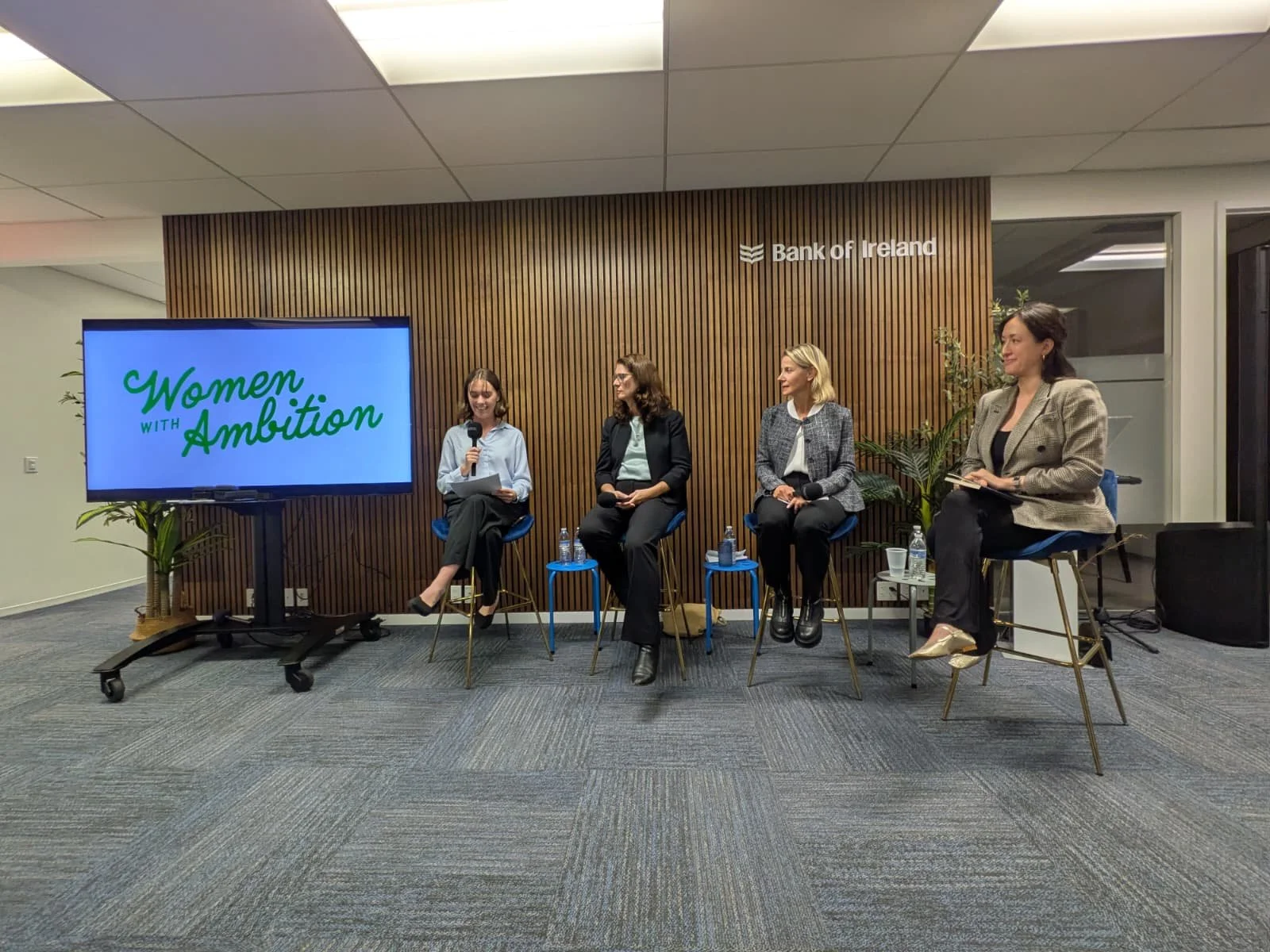
One of the highlights of my time in New York for Climate Week was joining the panel Global Goals, Local Leaders: Women Leading Sustainability's Next Chapter, hosted by Women with Ambition at the Bank of Ireland NYC Hub on Wednesday, 30 September.
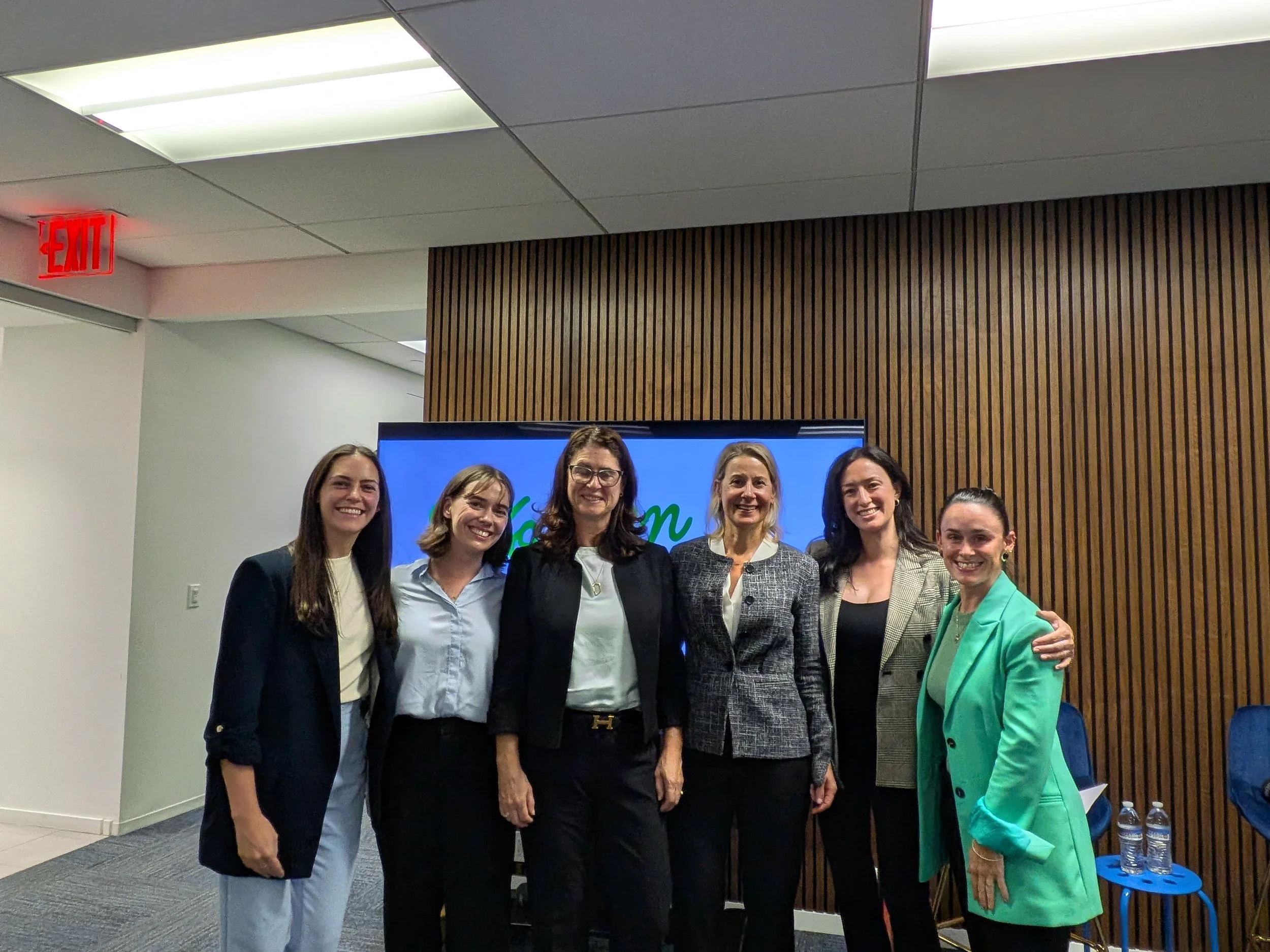
From left to right: Roisín Flynn, Lily Hasset, Janet Walsh, Pamela Kauppila, Laura McDermott, Jane McCooey
The room was full of women working in, or passionate about, sustainability, climate, ESG and impact. Our moderator, Lily Hassett, framed the evening around a simple idea: sustainability has moved from promises, to pledges, to the measurement of progress and performance. Over the course of the conversation we looked at how we got here, where things stand today, and where they're going next.
What struck me most was how differently each of us had arrived in this field, and how much that variety of paths is itself part of the answer.
Meet the panel
Lily Hassett (moderator) is studying Sustainability Management at Columbia University and is a Climate Knowledge Fellow at Columbia Business School. She most recently worked with BloombergNEF's Utilities & Grids team. Before that, she developed floating solar projects across New York, New Jersey and Massachusetts at Laketricity. A Trinity College Dublin graduate, Lily is especially interested in energy infrastructure, project finance and the investment needed to accelerate the energy transition.
Janet Walsh is In-House Counsel at Pfister Energy, a commercial and industrial solar and energy storage developer and EPC contractor in New Jersey. She came to clean energy after a 28-year litigation career, most recently as Managing Partner of Locks Law Firm's New York office. She is a past president of the Irish American Bar Association of New York. Originally from Limerick, Janet studied law at University College Dublin and completed an MS in Sustainability Management at Columbia in 2025. As she likes to say, her midlife crisis brought her to the climate crisis.
Pamela Kauppila is Director of Sustainability at New Mountain Capital, which she joined full-time in 2021 after starting as a sustainability consultant there in 2020. Her background is in finance, as an equity analyst at Gilder Gagnon Howe & Co., in private equity at Goldman Sachs, and in distressed debt and leveraged lending at BNP Paribas. She holds an MBA in Finance from NYU Stern and an MS in Sustainability Management from Columbia.
…And yours truly.
Past: how we got here
Lily started by asking each of us to describe working in sustainability today and how we arrived into this area. We also each named one misconception we'd like to clear up.
We then looked back at the sustainability "boom" of around 2021, and what drove it in each of our industries. In Europe, a big part of that momentum came from regulation. Reporting requirements like the CSRD put sustainability on the agenda of tens of thousands of businesses almost overnight.
The flip side is that many organisations first met sustainability as a reporting task. It went to finance or compliance and stayed in a silo, separate from strategy, product and marketing. If I could change one thing about that early phase, it would be to treat sustainability as a design and business-model question from day one, not something added once the decisions have already been made.
Pamela reflected on how the language has shifted, from "ESG" to "sustainability" in her own job title, and changes seen since the early 2020's.
Present: from greenwashing to greenhushing
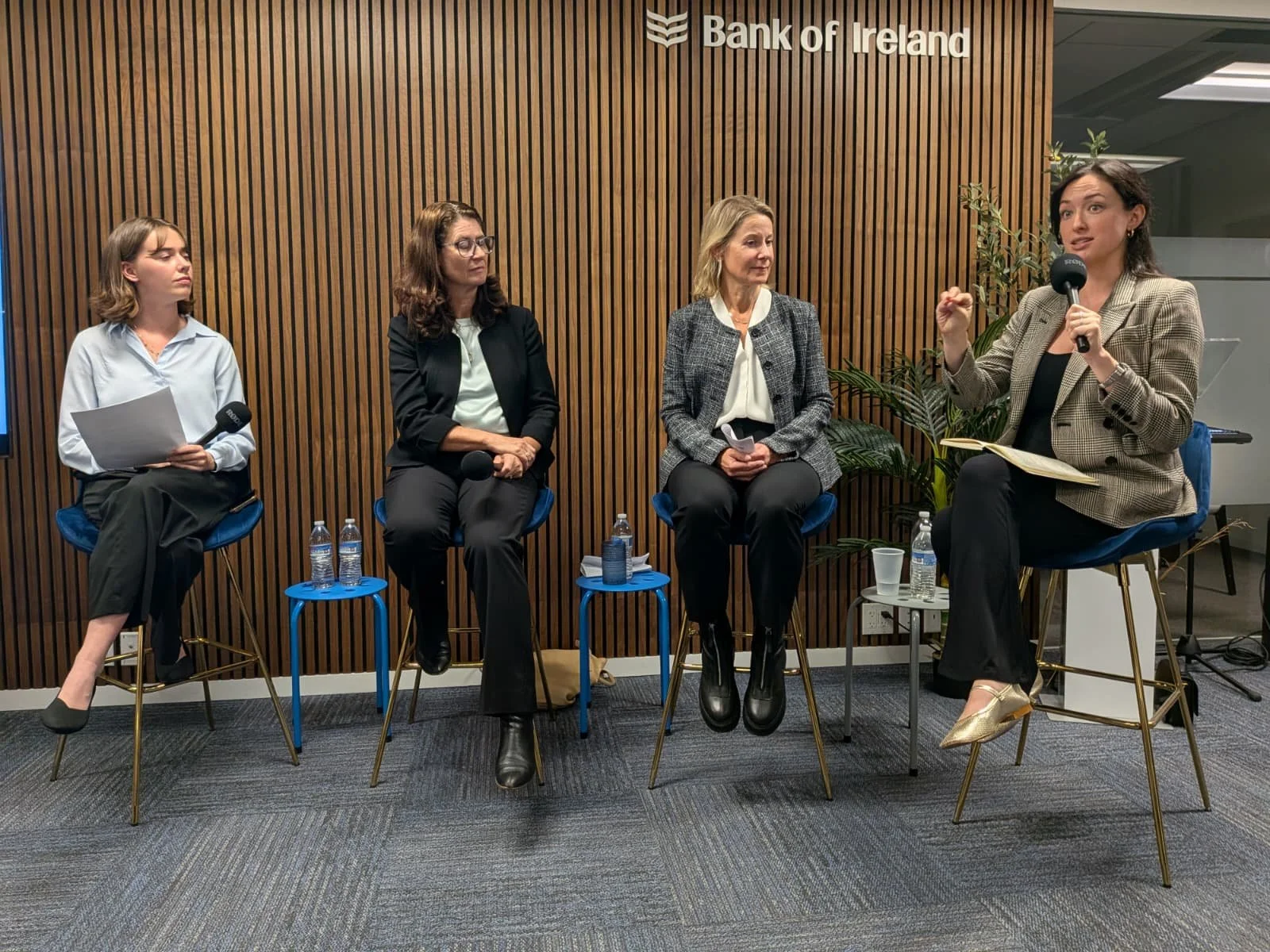
One of the richest parts of the conversation was about communication. We're moving to a period where companies are called out for greenwashing while also running the risk of "greenhushing", saying less about their sustainability work for fear of getting it wrong.
From where I sit in Europe, the rules are getting clearer. The EU's Empowering Consumers for the Green Transition Directive (ECGT) has applied since 27 September 2026. It sets out which generic claims are off-limits and what evidence you need behind the claims you do make. IMHO most greenwashing is accidental, not malicious. The answer to that isn't silence. It's capability building: helping teams, agencies and partners understand how to talk about their work credibly.
Janet spoke about decarbonisation, energy security and affordability, the three big priorities for the US energy system, and the role solar and battery storage can play in all three.
Future: what comes next
Looking ahead, Lily asked us about where we see the biggest opportunities for sustainability over the next five to ten years, and the types of careers that may emerge. For me, the biggest opportunity is in moving sustainability upstream, into the business model and the design process itself. When teams map their business model, they quickly see that sustainability touches every part of it: value propositions, channels, resources, costs and revenue. That's where the real innovation lies, in materials, in circular models and in new services.
Pamela, Janet and I also reflected on the nature of non-linear careers and how, despite coming from different realms (legal, finance, design), we've all found our way into sustainability through passion and curiosity.
A huge thank you to Women with Ambition for organising the evening, to the Bank of Ireland NYC Hub for hosting us, to Lily for steering the conversation so thoughtfully, and to Janet and Pamela for their honesty and insight. And thank you to everyone who came along, asked questions and stayed to talk afterwards.
If you were there, or if any of this resonates, I'd love to keep the conversation going. Get in touch or connect with me on LinkedIn.
