
Welcome to the Colectivo Featured Fellows Podcast, a dedicated series designed to explore the human stories, diverse cultures, and innovative ideas driving the future of sustainability.
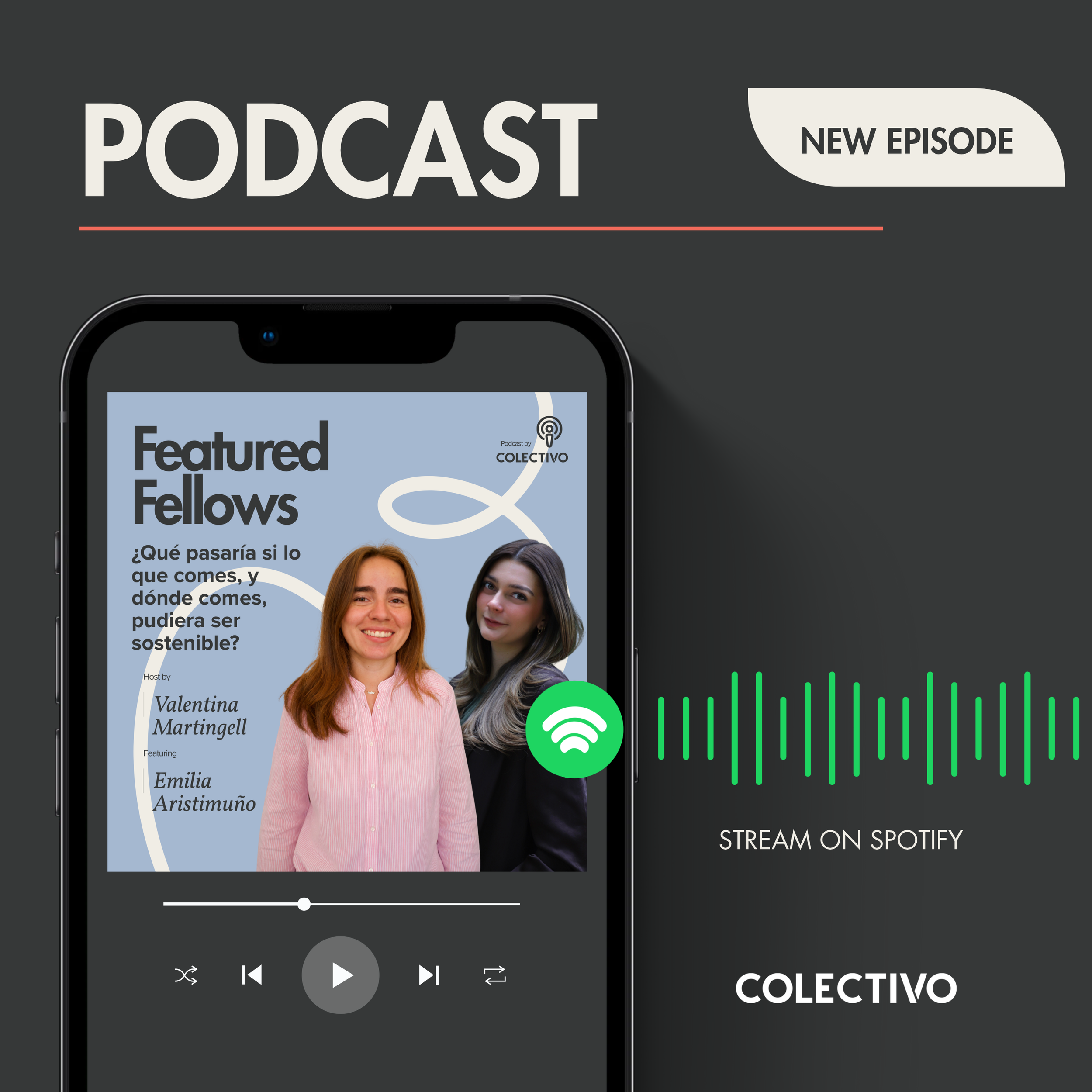
In this fourth episode, our host, Valentina Martingell, sits down with Colectivo Fellow Emilia for a conversation conducted entirely in Spanish. As an international consultancy, Colectivo operates across several countries, continents, and cultural contexts. Publishing this episode in Spanish is a deliberate celebration of this linguistic diversity, demonstrating that the transition to a sustainable economy requires cross-cultural dialogue and local storytelling.
In this episode, Valentina and Emilia explore how sustainability can be deeply woven into physical spatial design, focusing on Madrid’s innovative gastronomy sector. By analysing three distinct urban spaces, Infinito Delicias, Move in Movement, and Tramo, they show how sustainable practices can be integrated as a core strategic framework, rather than a superficial marketing afterthought.
👉 Listen to Episode 4 on Spotify
Moving Beyond the Eco-Label: Sustainability as the Starting Design
For many consumer-facing businesses, sustainability is treated as an optional, late-stage addition. A restaurant might establish its menu, design its physical layout, set up its operations, and only then ask: "How can we make this sustainable?" This approach typically leads to isolated, superficial adjustments, such as introducing compostable straws, adding an organic dish to the menu, or placing recycling bins in the dining room.
While these efforts are positive, they do not address the deeper, systemic impacts of a business's operations.
Emilia's research highlights a more powerful paradigm: integrating sustainability at the absolute beginning of the design process. When sustainability acts as the starting framework, it ceases to be a restriction and becomes a rich source of creative innovation, spatial identity, and business model transformation.
The Madrid spaces analysed in the podcast demonstrate that every aspect of a business: architectural materials, energy systems, ingredient sourcing, local community relationships, and financial structures, can be designed to work together as one resilient, circular system.
Three Madrid Case Studies: Circularity in Action
To demonstrate how this integrated design works in practice, Emilia and Valentina explore three pioneering models in Madrid:
1. Tramo: The Invisible Architecture of Sustainability
Tramo is a restaurant designed with circularity at its core. Rather than purchasing new, mass-produced furniture, the creators curated local, reused, and salvaged materials to build their physical space.
Furthermore, the restaurant utilises advanced, closed-loop systems for energy and water conservation. However, many of these highly sustainable operational decisions are completely invisible to the casual diner.
They only become clear when you ask questions or learn the story behind the space. This design philosophy shows that sustainability does not need to be performative to be highly effective. It can live quietly within the structural bones of a business.
2. Move in Movement: Physical Spatial Flexibility
Move in Movement challenges the traditional, rigid boundaries of retail and dining spaces. By designing a highly flexible environment that can adapt to different community needs throughout the day, the creators optimise resource use, reduce physical waste, and maximise local engagement. This focus on adaptive space-planning represents a core principle of our Redesign services at Colectivo, showing that resource efficiency begins with thoughtful structural layouts.
3. Infinito Delicias: Gastronomy, Coworking, and Community Impact
Infinito Delicias serves as a brilliant example of a multi-dimensional business model. It seamlessly merges gastronomy, shared coworking infrastructure, cultural events, and direct social impact.
By sourcing local, seasonal ingredients, the space supports regional agricultural networks. Simultaneously, by offering a welcoming physical space for collaboration and cultural exchange, it builds strong, resilient relationships with its local neighbourhood. Infinito Delicias demonstrates that environmental responsibility and social impact can support long-term business health and financial profitability.
The Takeaway for Business Leaders: Designing for Longevity
For organisations looking to build physical spaces, retail environments, or service models, Emilia's insights provide a clear strategic challenge. Sustainability is not a certification or a marketing label to be applied at the end of a project. It is a comprehensive way of designing decisions around people, place, resources, and community from the very start.
Through Colectivo’s Redesign and circular innovation frameworks, we help businesses move past superficial sustainability efforts. We facilitate collaborative design sprints that allow organisations to map their material inputs, evaluate physical space usage, and co-create services that reduce environmental footprints while elevating the customer experience.
Are you ready to redesign your business model, services, or physical spaces with sustainability at the core? Contact Colectivo today to discover how our Redesign and co-creation services can help you build circular, profitable, and memorable customer experiences.
👉 Listen to Episode 4 on Spotify
