

Insights from Colectivo
Sharing what we’re learning as we help organizations navigate change.
Here, our team shares ideas, lessons, and stories from the field, offering fresh perspectives on what it takes to build resilient, future-ready organizations.

Behaviour Change for Sustainability Is Live and Free (For a Limited Time)
We’re excited to share that our new online course, Behaviour Change for Sustainability, is now live.
For a short pre-launch period, we’ve made the course free to access. This is a deliberate choice, one rooted in how we believe sustainability learning should work.

Why Sustainability Fails at the Decision Level
Every year, leadership teams set ambitious sustainability targets. Net-zero roadmaps. ESG commitments. Purpose statements approved at board level. And yet, many of these initiatives stall.
Not because decision-makers lack intent, resources, or intelligence, but because intentions are mistaken for execution.
This is a classic behavioural science problem known as the Intention-Action Gap.


Give the Gift of a Greener Future: Colectivo's Holiday Offer on Sustainability in Practice
As the year winds down and the holiday season approaches, it’s the perfect time to think about meaningful gifts; gifts that inspire growth, knowledge, and a commitment to a better future. What better way to prepare for a successful and sustainable 2026 than by investing in essential skills?
This holiday season, give the gift of expertise with Colectivo's "Sustainability in Practice" online course, available now at a special discounted rate.

Ireland Approves 13 Sectoral Adaptation Plans: Here’s What It Means for Business, Resilience and Funding
The Irish Government has officially approved 13 new Sectoral Adaptation Plans (SAPs), a critical step in protecting our economy, society, and ecosystems from the growing risks of climate change.
These adaptation plans provide strategic direction across key sectors, with actions designed to manage increasing threats such as flooding, extreme weather events, supply chain disruption, and infrastructure failure.

Reflections from Web Summit Lisbon 2025 - Part #2
Reflecting on our time at Web Summit 2025, we’ve gathered the lessons that stood out the most, insights that left a lasting impression and are worth sharing.

Reflections from Web Summit Lisbon 2025 - Part #1
In this blog, we reflect on our time at the Web Summit 2025 by exploring two key questions: ‘What was the single most valuable insight or idea we gained from the event?’ and ‘Which moment from the sessions will stick with us, and why?’

From Waste to Willingness: A Behavioural Design Approach to Recycling in Lebanon
In this week’s Behavioural Design for a Sustainable Future feature, we spotlight Christina Abouhamad, a strategic communications leader from Lebanon and a recent graduate of the Master in Customer Experience and Innovation at IE Business School.

Mind the Gap: From Intention to Action
In this week’s Behavioural Design for a Sustainable Future feature, we spotlight Catalina Gómez, whose project tackles one of the most stubborn challenges in sustainability: the intention action gap.

Turning Solidarity into Action: A Behavioural Design Approach
In large institutions, values like “solidarity” and “social responsibility” are often stated, but not always practiced. In this week’s Behavioural Design for a Sustainable Future feature, we spotlight Liliana María Quintanilla Viaud, a financial analyst and project manager currently pursuing a dual MBA and Master in Customer Experience and Innovation at IE Business School.

The Just Transition as a Design Challenge
As sustainability standards evolve, so too must the way we frame and communicate them. In this week’s feature for Behavioural Design for a Sustainable Future, we’re highlighting the work of Lena Boudart, a Master’s candidate in Customer Experience and Innovation at IE Business School. With a background in digital media and a deep commitment to ethical innovation, Lena’s work reimagines sustainability not as a burden, but as a behavioural design opportunity.
♻️What If Engagement Could Do More Than Raise Awareness?
We’re often told that behaviour change comes from information, incentives, or regulations. And while those tools can help, they don’t tell the whole story.
The effectiveness of sustainability initiatives may be increased when they appeal to individuals' emotions, values, and identity, rather than relying solely on rational arguments or external incentives.

Dark Patterns and the Ethics of Friction
In the digital world, design decisions can influence behaviour in powerful and often invisible ways. This week in our Behavioural Design for a Sustainable Future student series, we’re featuring Valentina Orellana Lasso, a product designer and current Master’s student in Customer Experience and Innovation at IE University.
Using Behavioural Models to Rethink Fast Fashion
In our Behavioural Design for a Sustainable Future series, we’re highlighting the work of students who are applying behavioural frameworks to real-world problems, not just in theory, but in action. This week, we’re featuring Francesca Ottaviano, a Master’s student in Customer Experience and Innovation at IE University, who brings a strong focus on retail, user experience, and ethical design.

Designing the Pause: Behavioural Campaigns for Conscious Fashion
At Colectivo, we believe great design doesn’t just make experiences better, it makes systems visible. That’s why, through our Behavioural Design for a Sustainable Future student series, we’re proud to spotlight emerging voices who are using behavioural insight to reimagine the everyday.
This week’s feature comes from Valeria Pérez Martínez, a strategic designer currently completing a dual master’s in Customer Experience & Innovation and an International MBA at IE Business School. With a background in branding and experience design, Valeria brings a storytelling mindset to questions of sustainability and impact.

Using Behavioural Design to Support Diabetes Patients
At Colectivo, we believe that designing for sustainability requires more than good intentions, it requires insight, structure, and above all, empathy. This belief is at the heart of our new series, Behavioural Design for a Sustainable Future, where we feature work from students in Laura McDermott’s IE University Master in Customer Experience and Innovation course.

Colectivo at South Summit 2025: Building a Regenerative Future Through Innovation
Valentina Martingell, our Design Analyst and Coordinator, represented Colectivo at South Summit Madrid 2025. A gathering of founders, investors, corporates, and creatives shaping the future of business and sustainability. As a consultancy rooted in regenerative thinking, we were particularly interested in how panels addressed the intersection of climate, innovation, and social equity.

The City of the Future: How to create sustainable spaces for People and the Planet 🏗️ 🌱
How can we make our cities more sustainable, resilient, and inclusive? How can we design and transform our urban spaces to cater to the needs of our people and the planet? What are the best practices and innovations that are happening around the world and how can we learn from them?

Micro to Macro: How to Actually Move Forward in the Green Transition
From ambition to delivery, using microgoals, practical project pathways, and strategic reflection to create meaningful sustainability progress.
We Need Big Goals: But We Also Need a Way to Get There
In the world of sustainability, ambition isn’t the problem. We see it every day: organisations aiming for net-zero, circular operations, climate resilience, and more.
But when it comes to actual delivery, big goals alone aren’t enough.
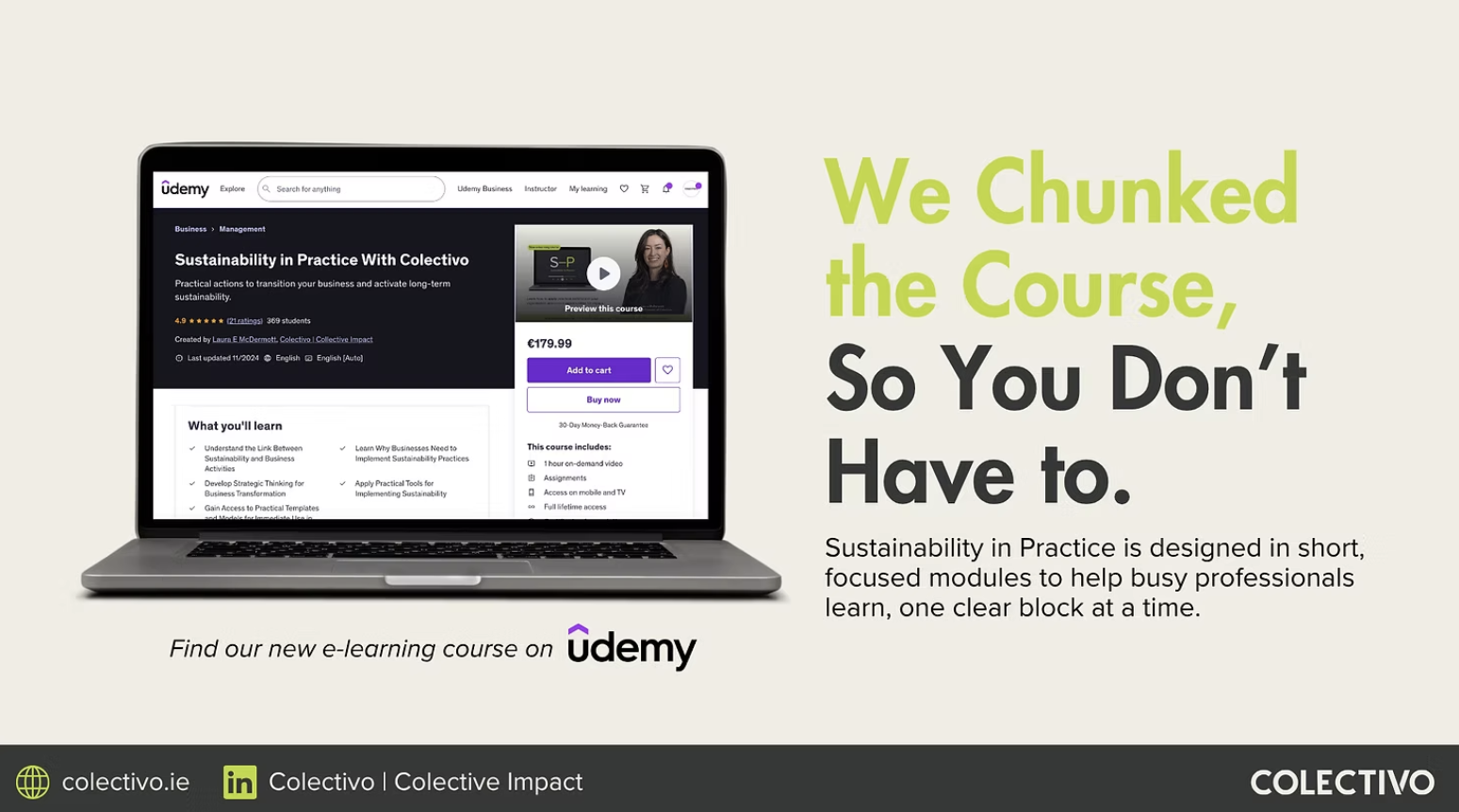
Chunking Strategy: The Smart Way to Deliver, Learn, and Lead
How corporate teams can reduce overwhelm and accelerate progress, and how we’ve built our newest course using the same principles.
Strategy Pressure Is Real
At this time of year, corporate teams are being asked to do a lot, fast. Accelerate delivery. Fix what’s underperforming. Keep innovation pipelines moving. And prepare for mid-year reviews, all while managing stakeholder expectations and sustainability demands.